25 Wins from 2025
that Shaped Urban Mobility
From the Desk of Aswathy Dilip
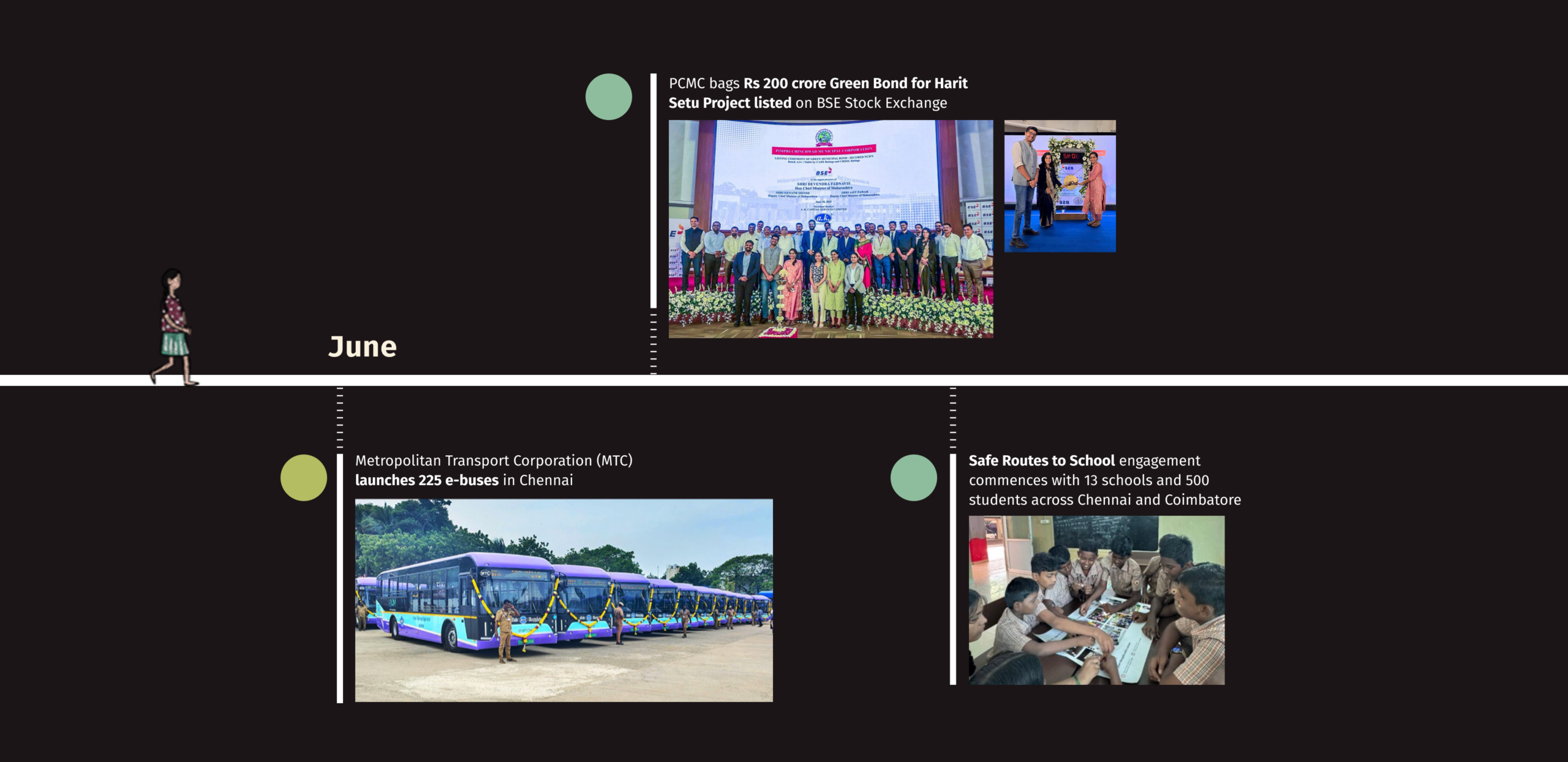
In the Chennai Metropolitan Area, the adoption of a Comprehensive Mobility Plan signalled a shared direction, but equally important was the fact that the city was already moving. Investments in 400+ electric buses, a Rs 200-crore budget to improve footpaths, and the adoption of a progressive parking policy unfolded alongside the planning process, reinforcing one another. Together, they reflected a shift from isolated interventions to a coherent approach of strengthening public transport, improving access, and rebalancing street space in favour of people. In Pimpri Chinchwad, the alignment took a different form but pointed to the same maturity: the city unlocked Rs 200 crore through green bonds for the Harit Setu project, demonstrating that when vision, credibility, and governance converge, climate-positive urban infrastructure can attract capital at scale.
None of this happened overnight. Long before these milestones, cities were building smaller projects with conviction. A footpath was never just a footpath. A charging-enabled bus depot was never just a pilot. Each intervention was designed as part of a larger system, one that recognises mobility as essential to access, dignity, opportunity, and climate responsibility. What changed in 2025 was that these efforts stopped operating in isolation. They began to speak to one another, and to roll out at scale.

Our 2025 Milestones
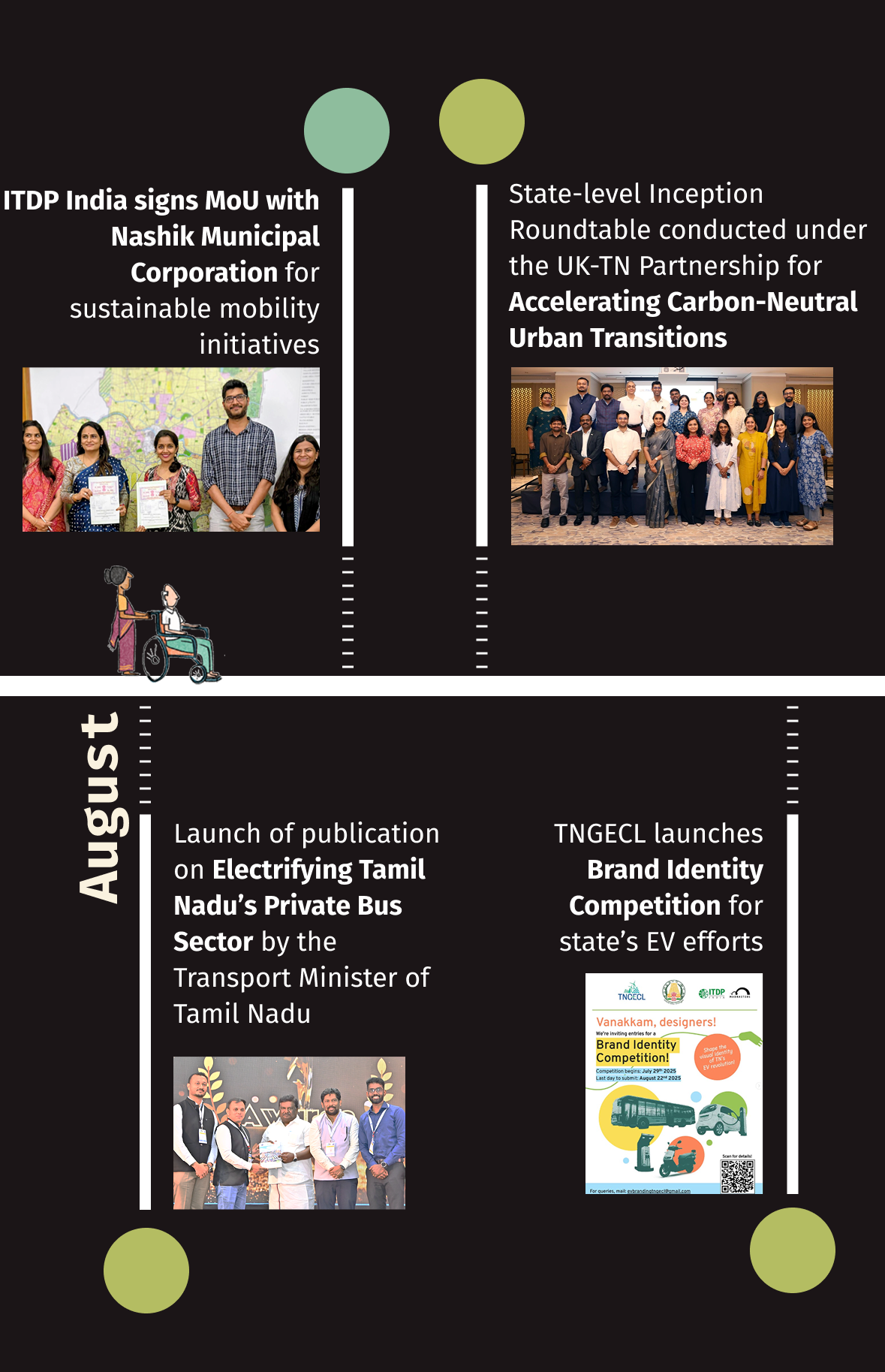
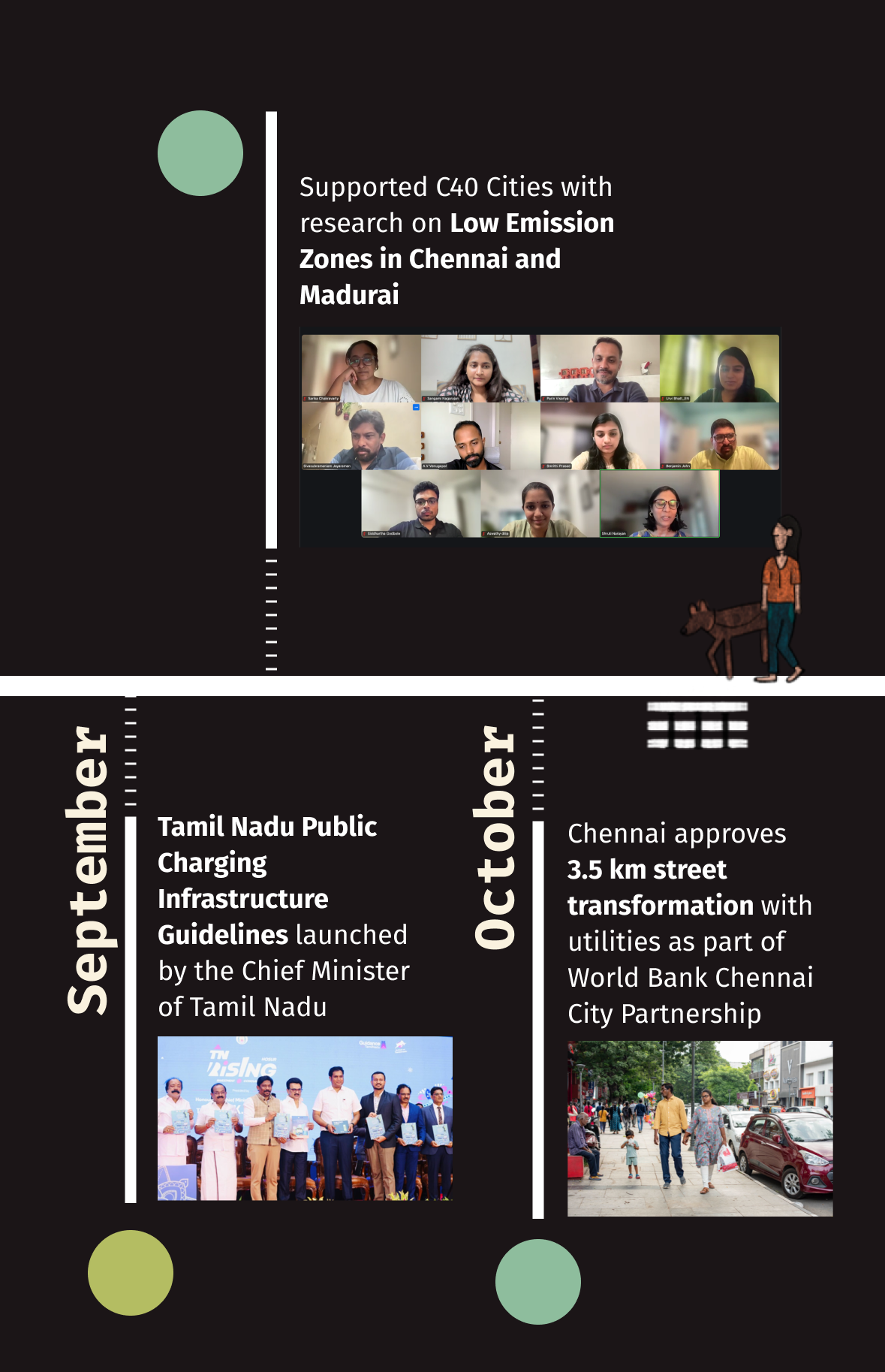
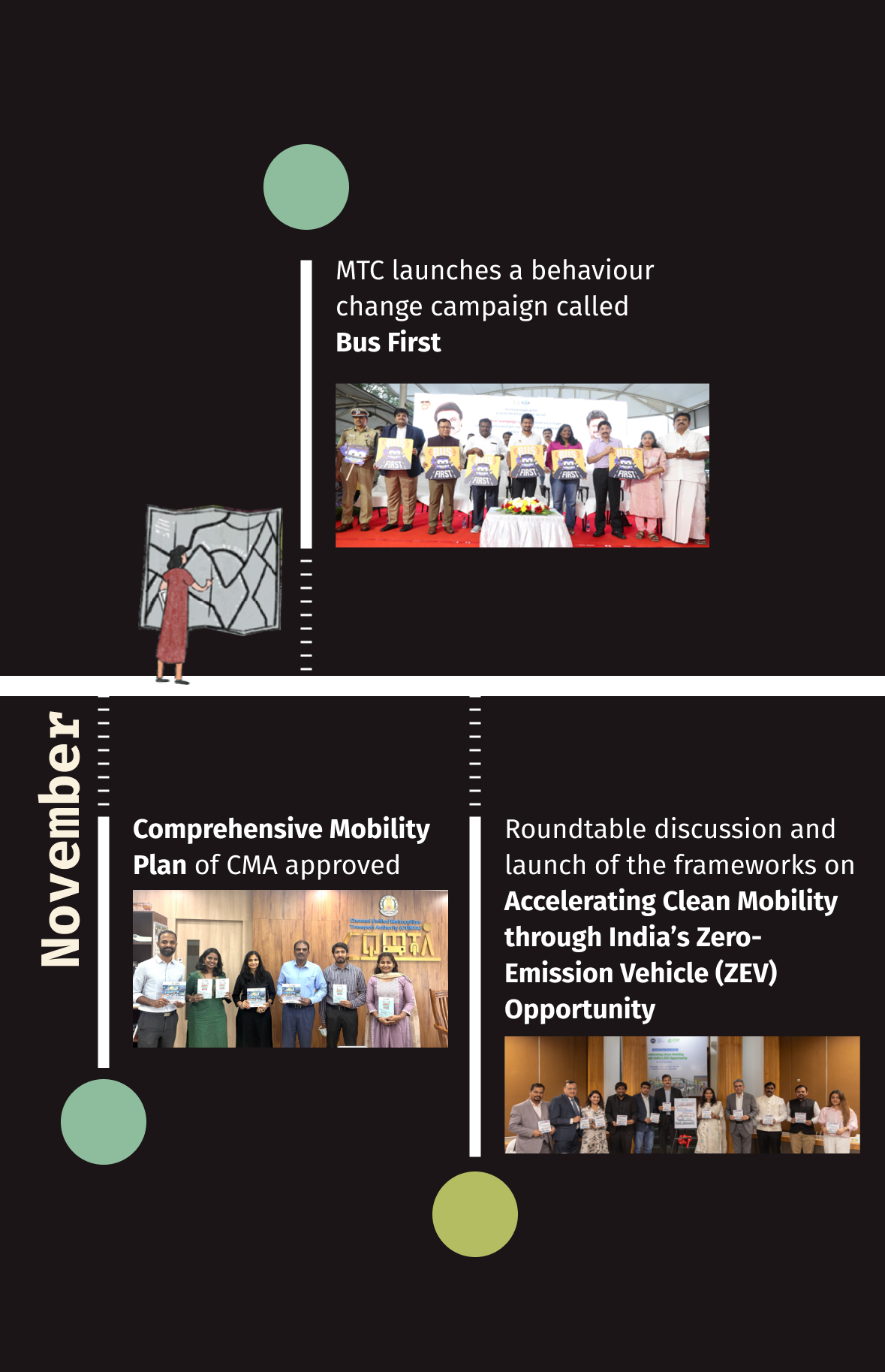
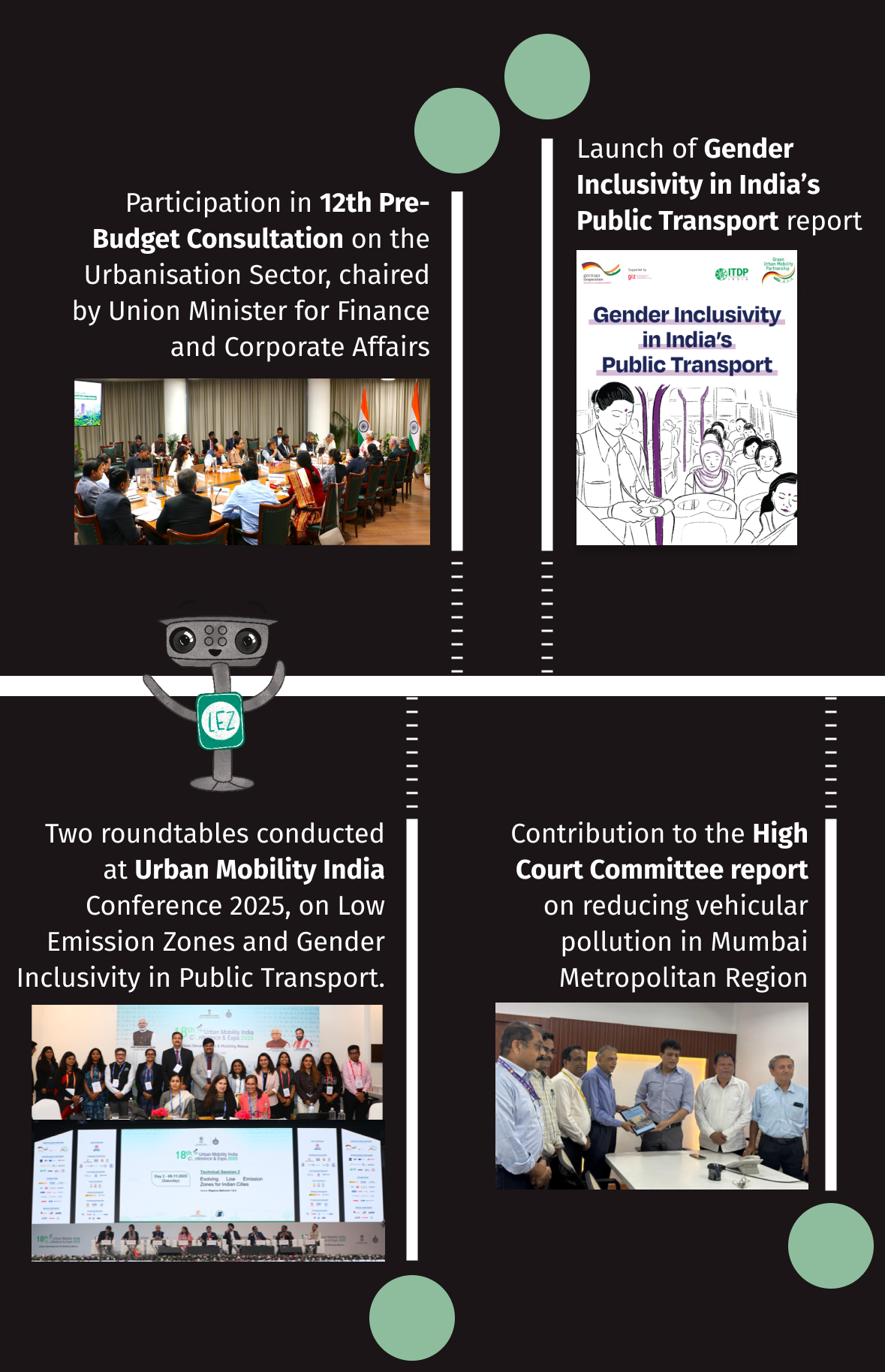
The Three Goals Guiding Us
At ITDP India, everything we do is guided by three goals: Increase public transport ridership, electrify urban transport systems, and secure funding at scale, to make the former two goals possible.
And what’s our grand vision? People-first, low-emission cities. In 2025, every win was shaped by these three goals, and this shared vision.
Some wins may look small on their own like a humble brick: a policy here, a budget allocation there, a guideline approved. But stack them together and you start to see the city being built to enable people moving smoothly, one sustainable decision at a time. Check out our crisp listicle on 25 wins from 2025 that Shaped Urban Mobility. This captures the winning moments of everyday work towards the big picture.
Brick by Brick: 25 Milestones that Shaped Our Cities
Increase Public Transport Ridership
Across India, we have been laying the bricks for a better way to move. That means making public transport the natural choice of commute by improving its service, making it easy to walk and cycle to access it, and managing the need for travel so fewer polluting vehicles are on the road. Here are some updates from our lighthouse cities, and work at the national and state-level, showing how that shared purpose is taking shape.
Across India, we have been laying the bricks for a better way to move. That means making public transport the natural choice of commute by improving its service, making it easy to walk and cycle to access it, and managing the need for travel so fewer polluting vehicles are on the road. Here are some updates from our lighthouse cities, and work at the national and state-level, showing how that shared purpose is taking shape.
Across India, we have been laying the bricks for a better way to move. That means making public transport the natural choice of commute by improving service, making it easy to walk and cycle to access public transport, and managing the need for travel so fewer polluting vehicles are on the road. Here are some updates from our lighthouse cities, and work at the national and state-level, showing how that shared purpose is taking shape.
1
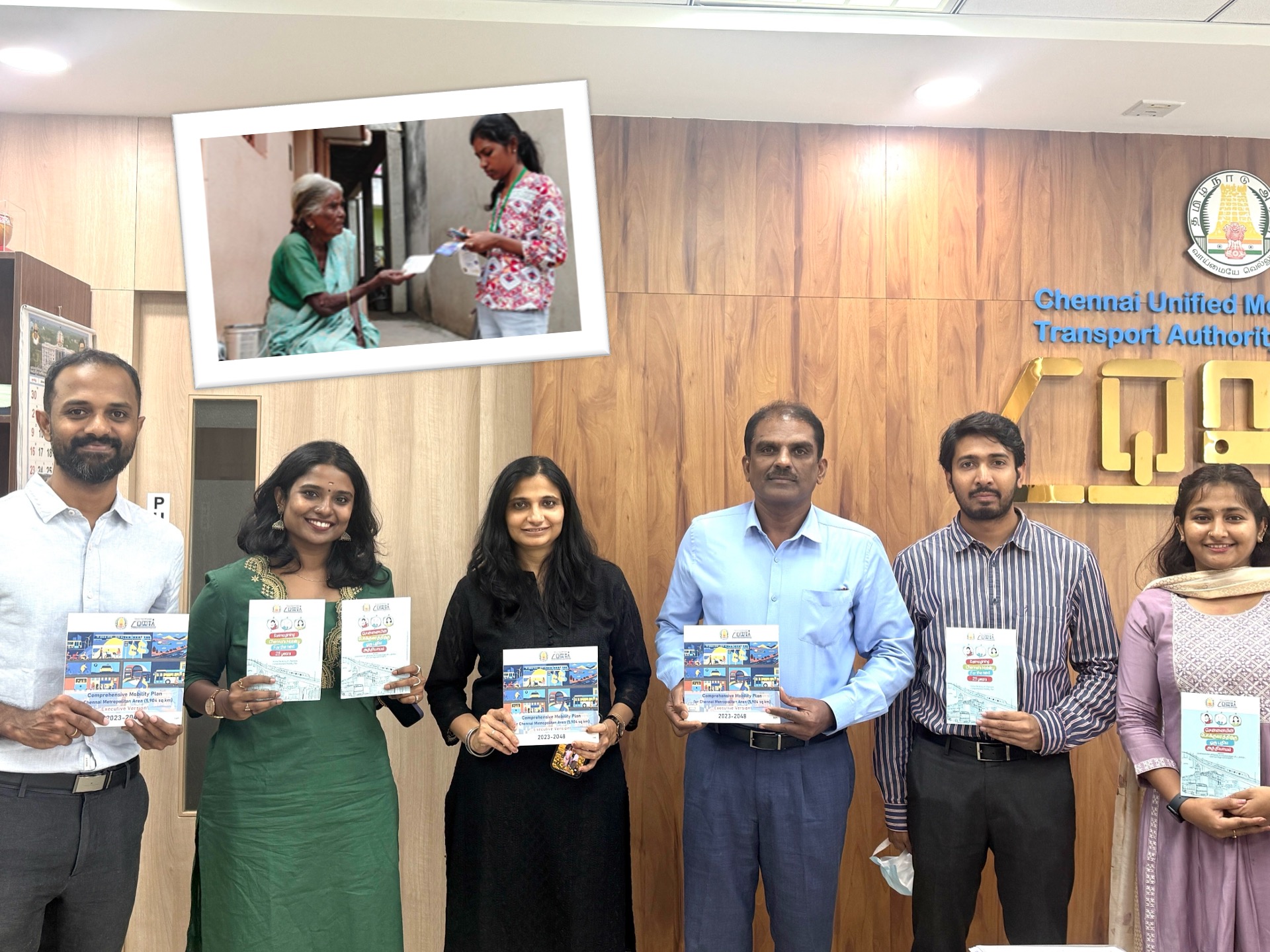
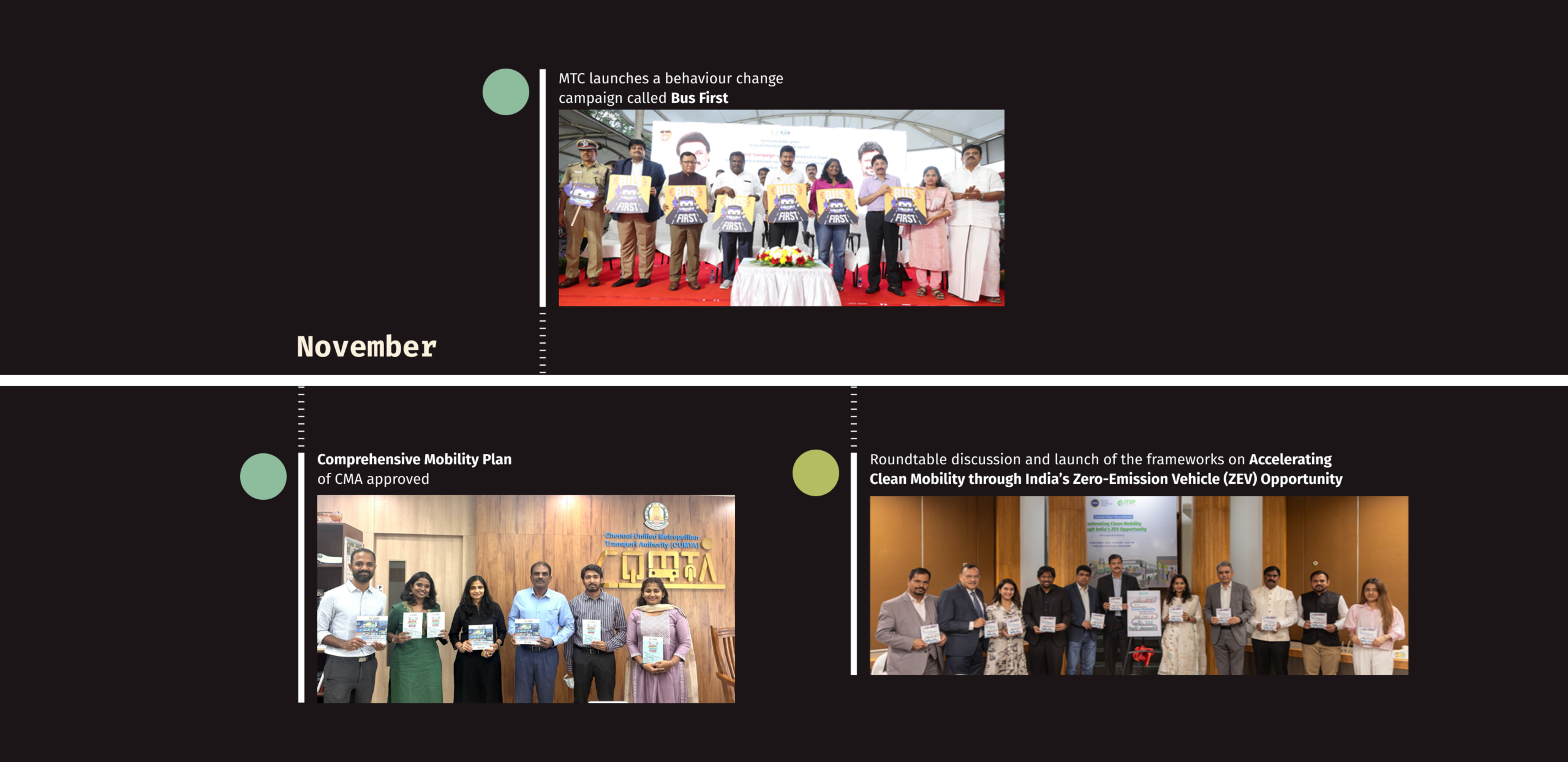
By 2048, Chennai’s mobility could look completely transformed! ITDP India supported the city’s Comprehensive Mobility Plan (CMP), guided by insights from 55,000 household surveys and 16 primary surveys. It integrates robust data-sharing systems and a centralised database. The CMP spans 12 municipalities and 4 municipal corporations, covering a whopping 5,904 sq. km. Imagine faster commutes across the city, public transport carrying 60% of trips, and streets designed for people, not cars. Check out the CMP here.
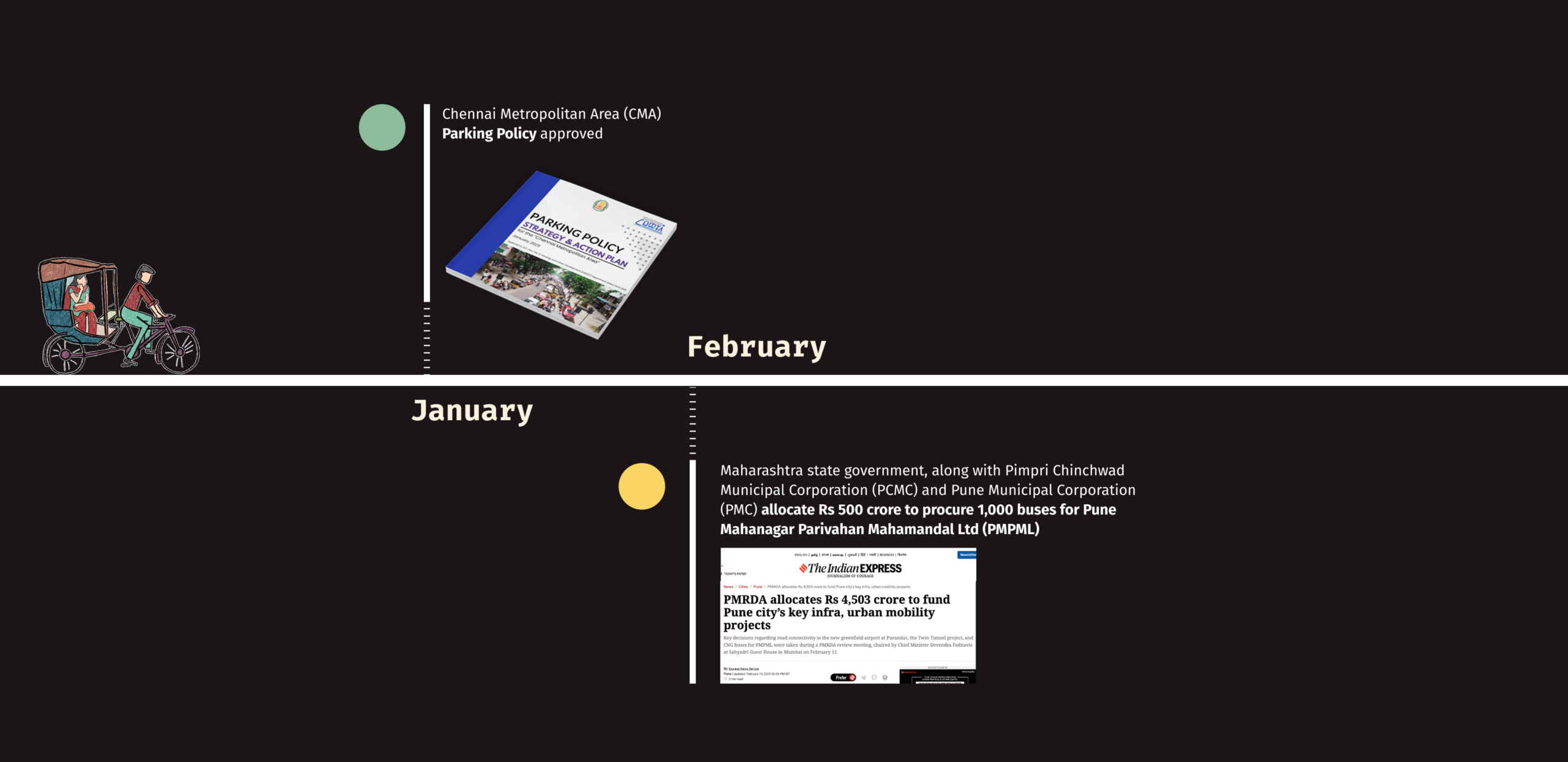
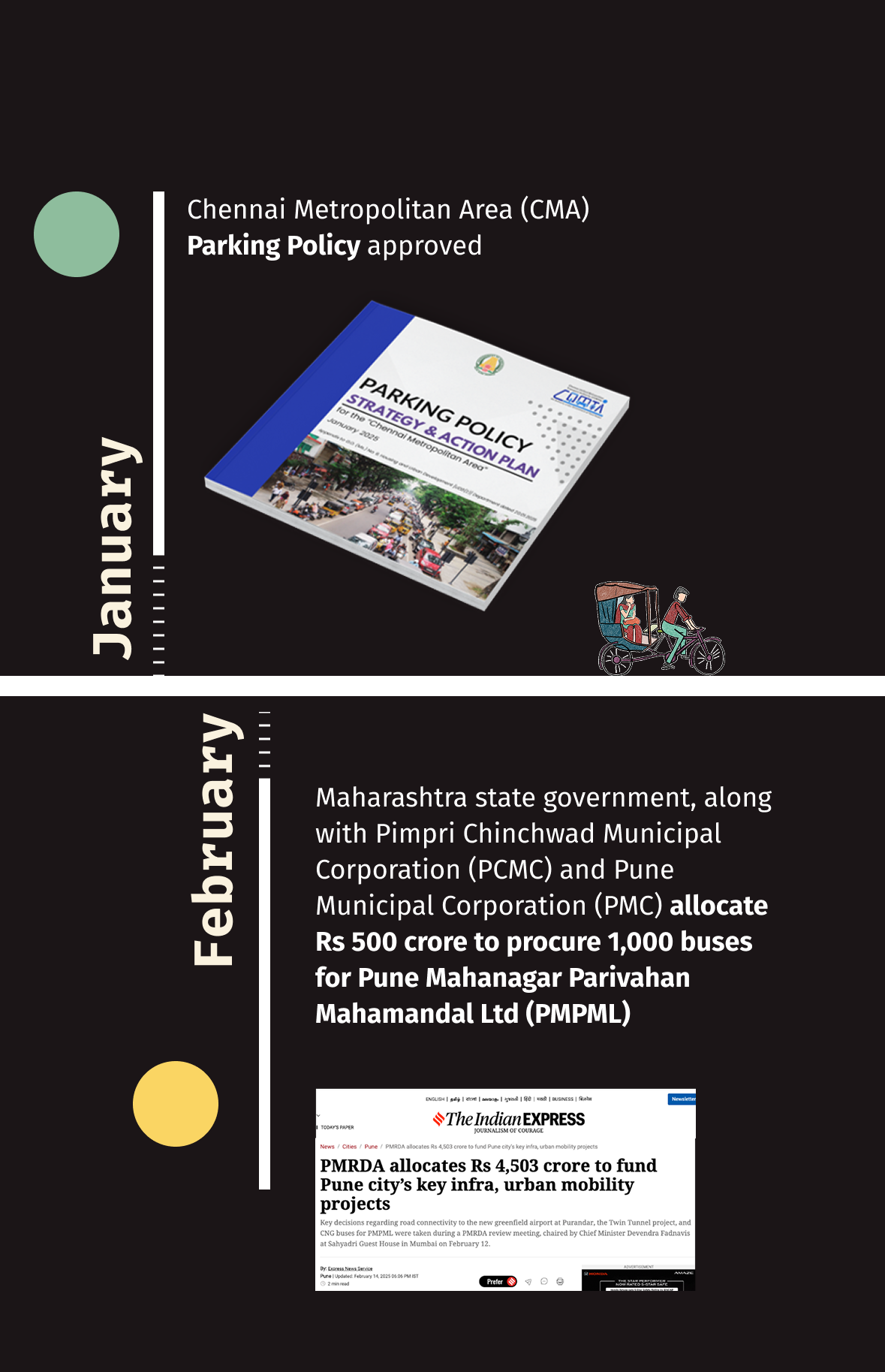
Managing streets differently can change how a city moves, and Chennai is proving it with the Parking Policy 2025. Spanning 5,904 sq. km, the policy introduces area-level parking management, demand-based pricing, and leverages smart technology for enforcement. Pilots in Anna Nagar and other neighbourhoods are already informing future rollouts.
2
3
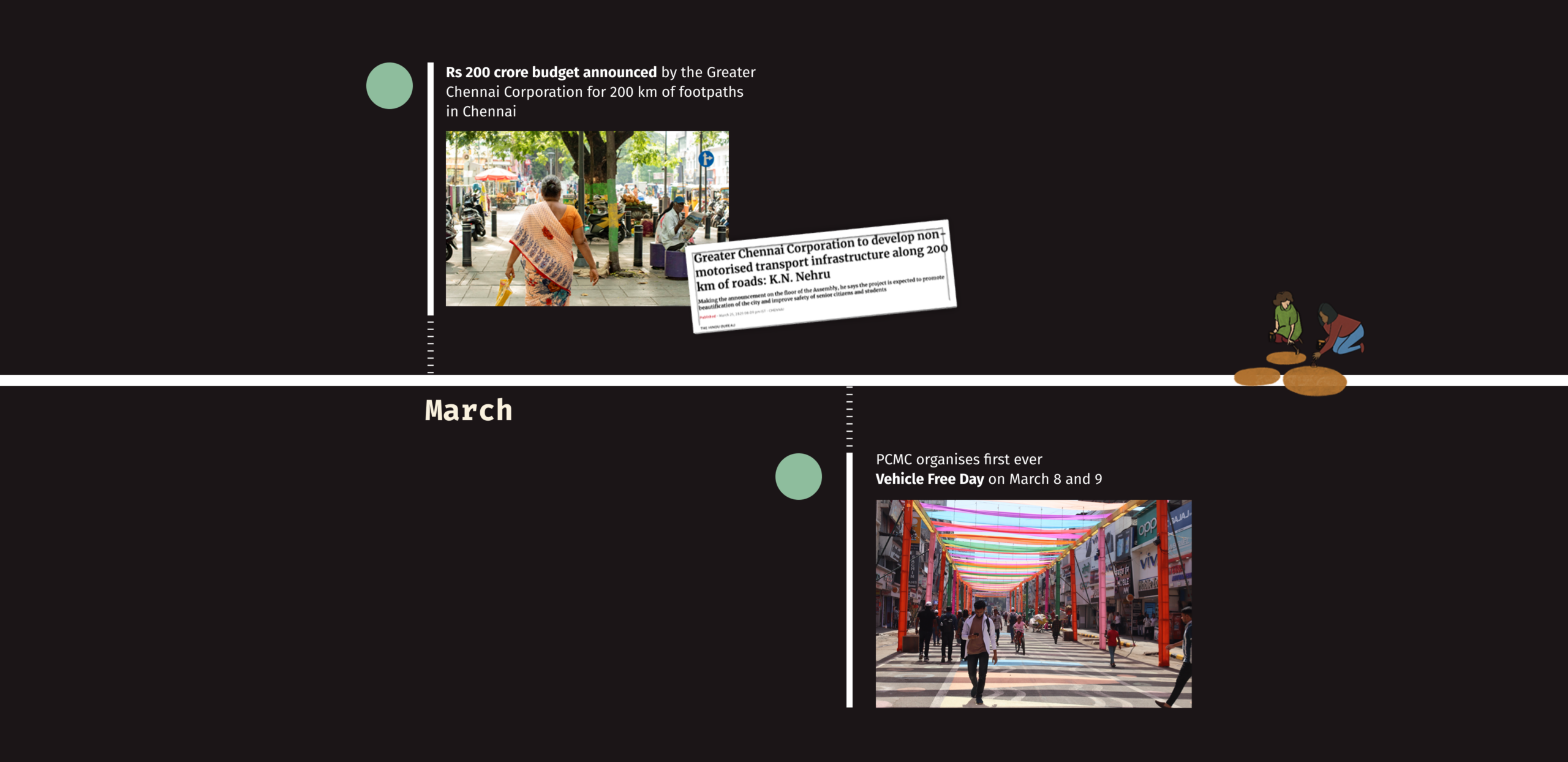
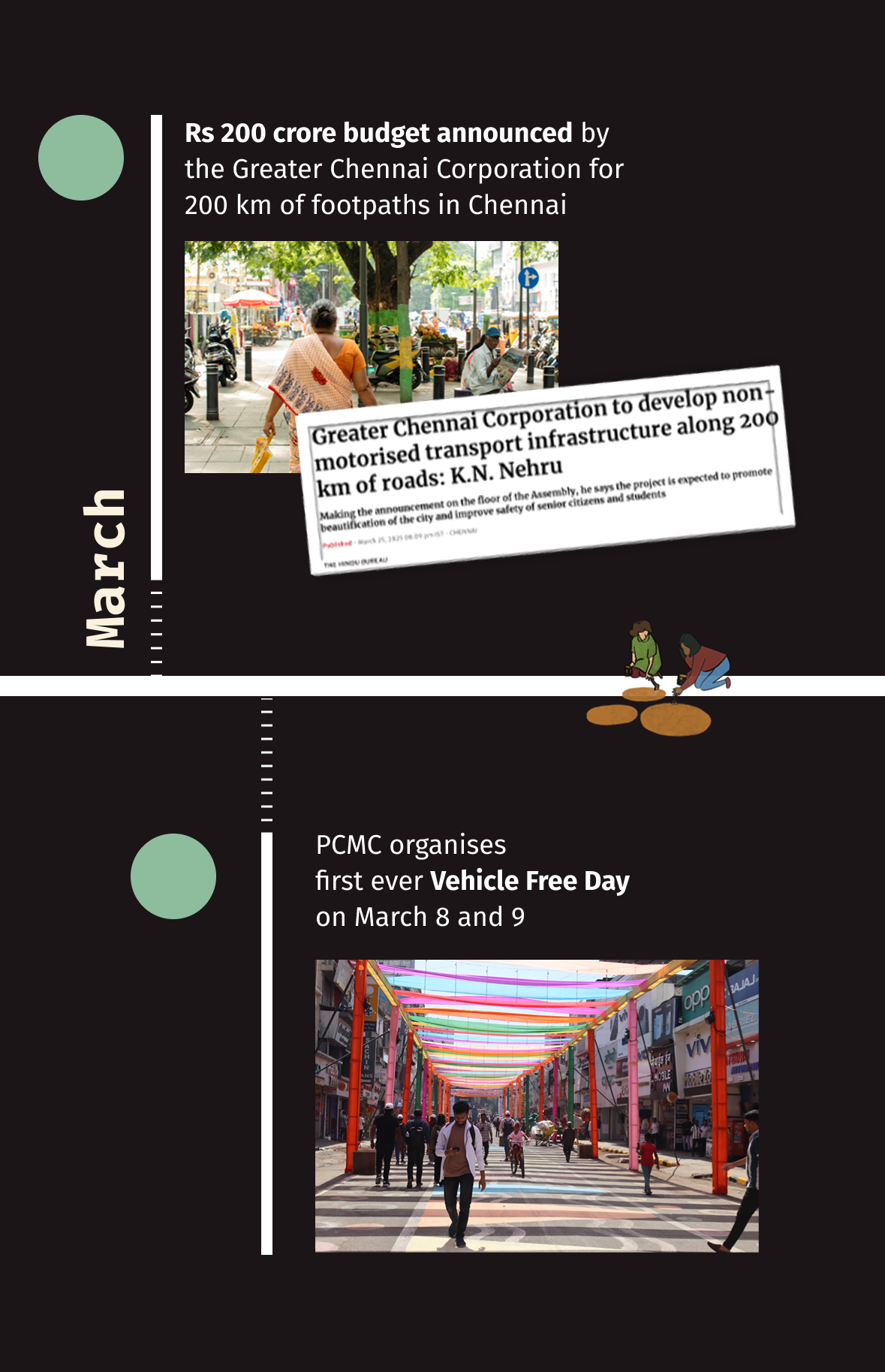
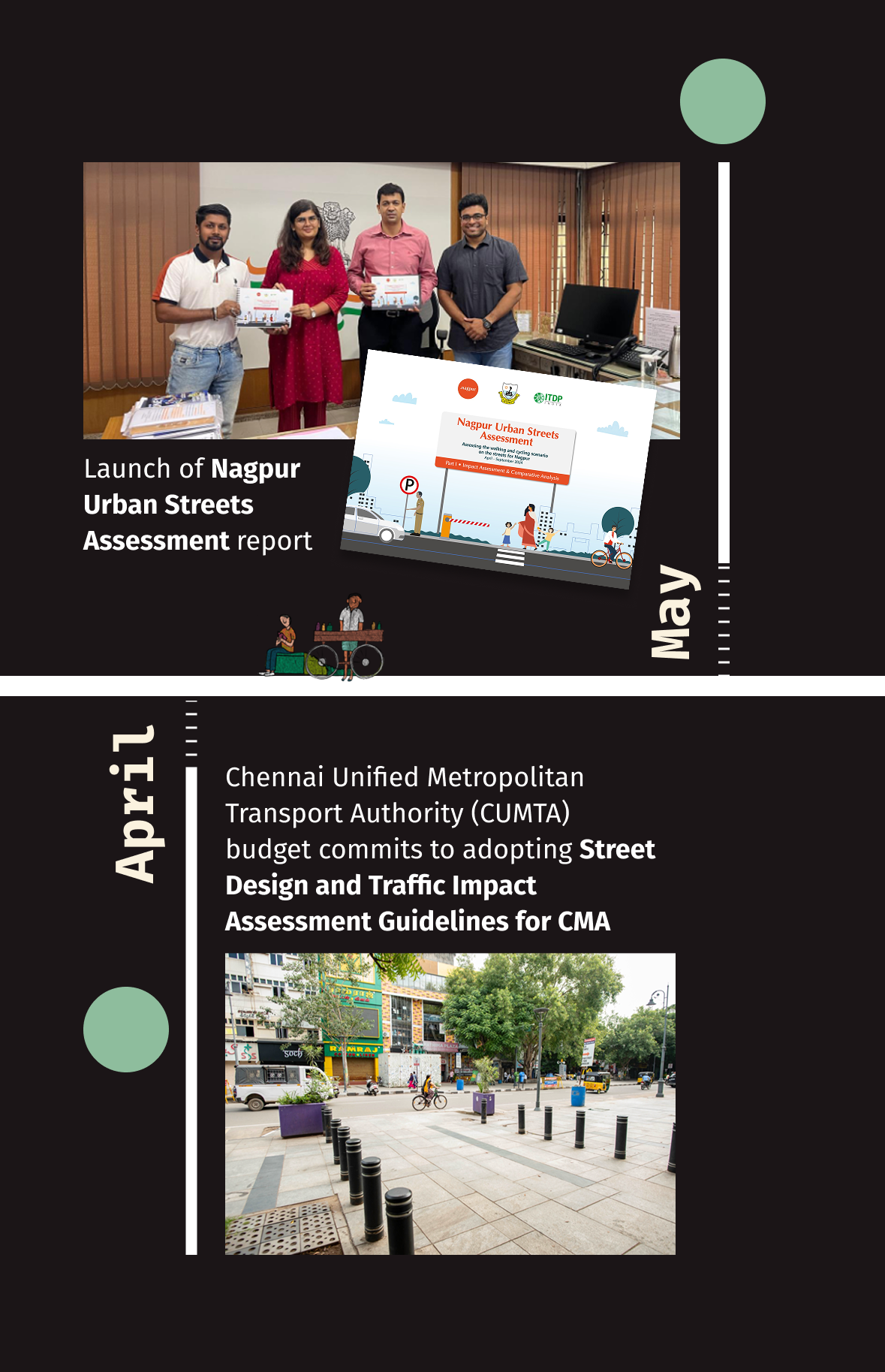
Transforming Chennai’s streets is years in the making, and 2025 marks a milestone. For the first time since the Non-Motorised Transport (NMT) Policy (2014), the city secured a Rs 200 crore budget to develop 200 km of footpaths. This decision was informed by the situational analysis, a study conducted by ITDP India in 2023-24 of 14 streets spread across 32 km. The study mapped footpaths and surveyed over 1,700 users to identify gaps, risks, and priorities for safer walking. The team also supported in preparing the Street Design (SD) Guidelines, with Child-Friendly Street Guidelines. Both of these are informing the Safe Routes to School initiatives in KK Nagar.
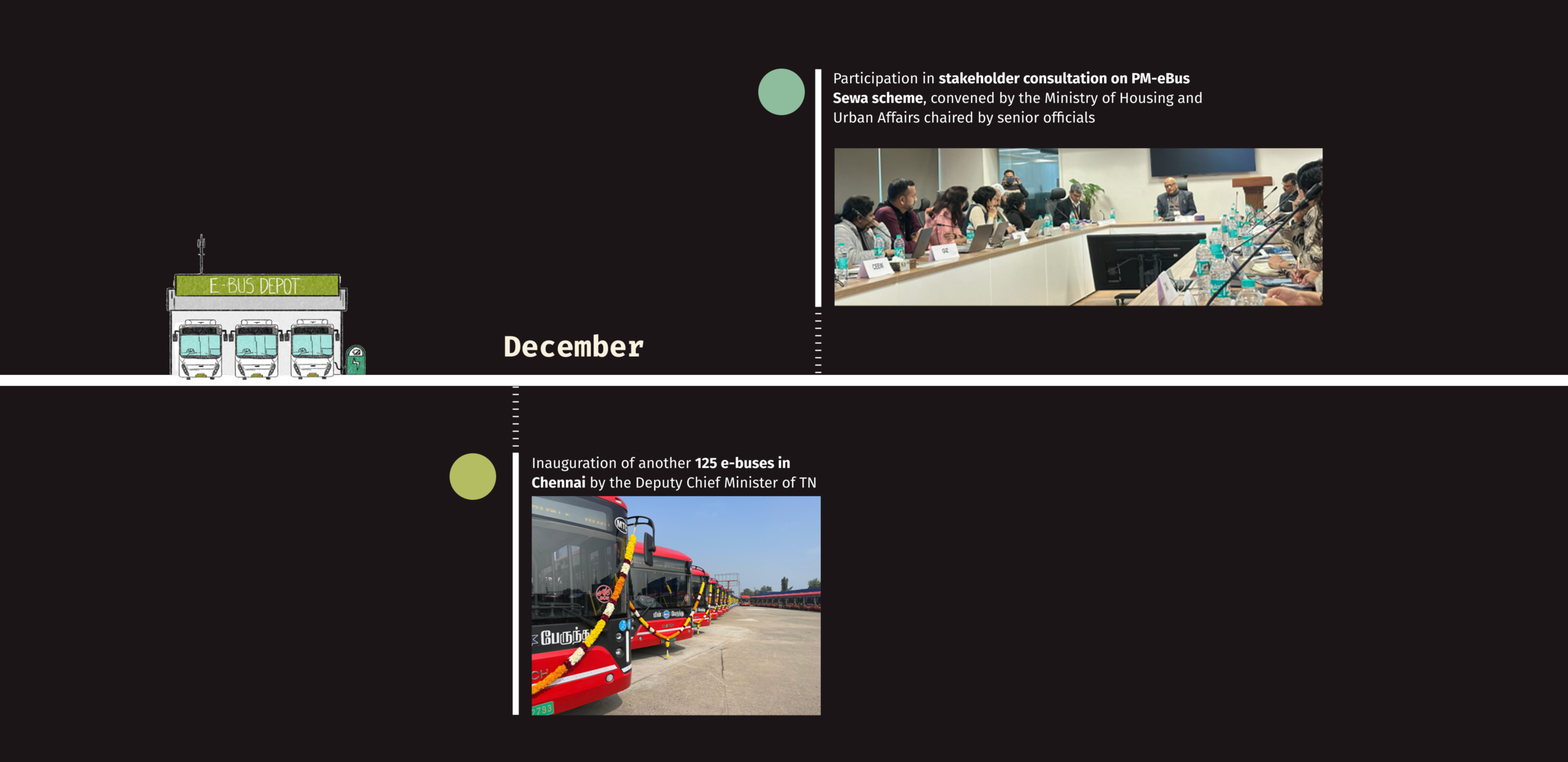
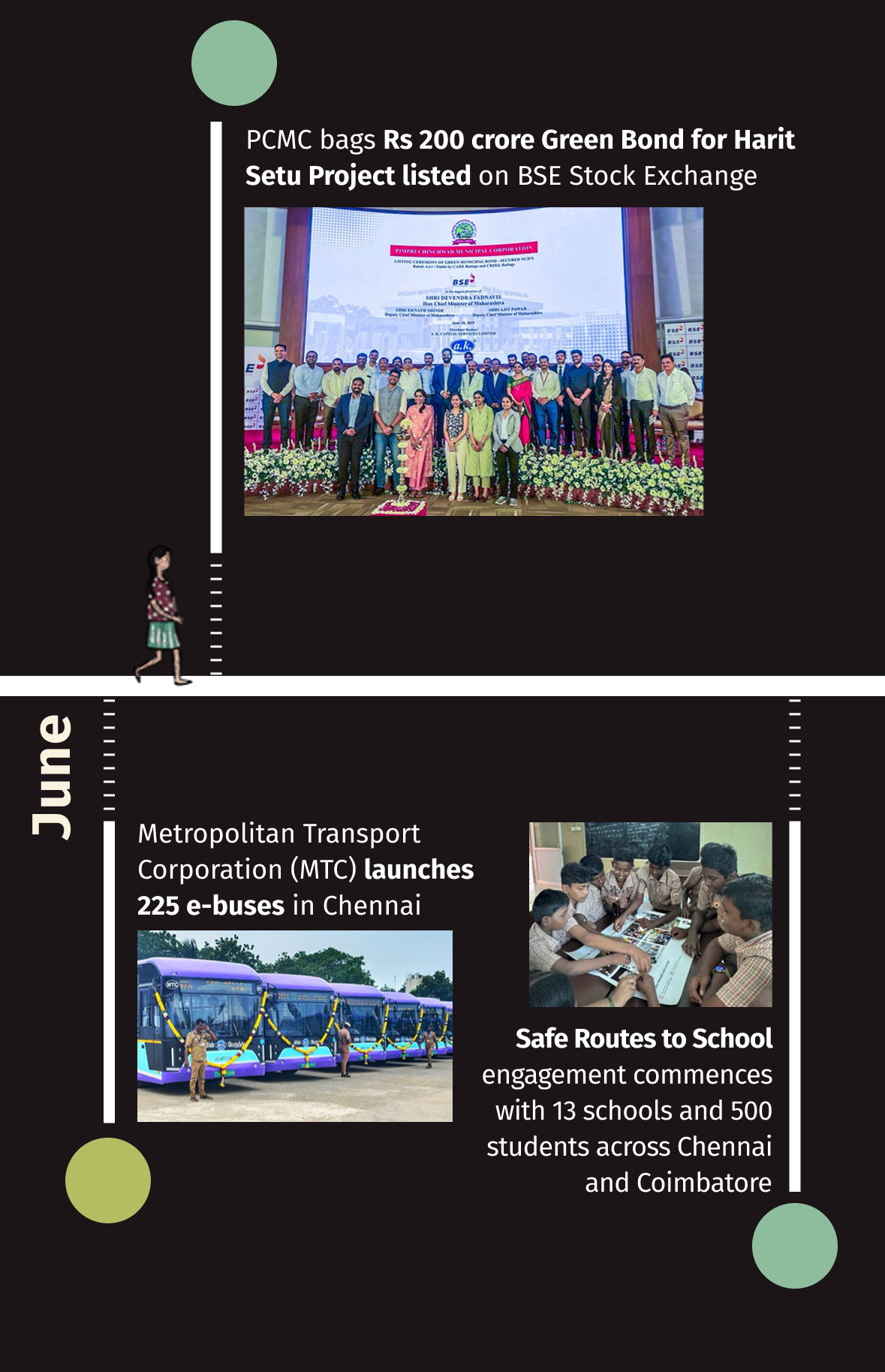
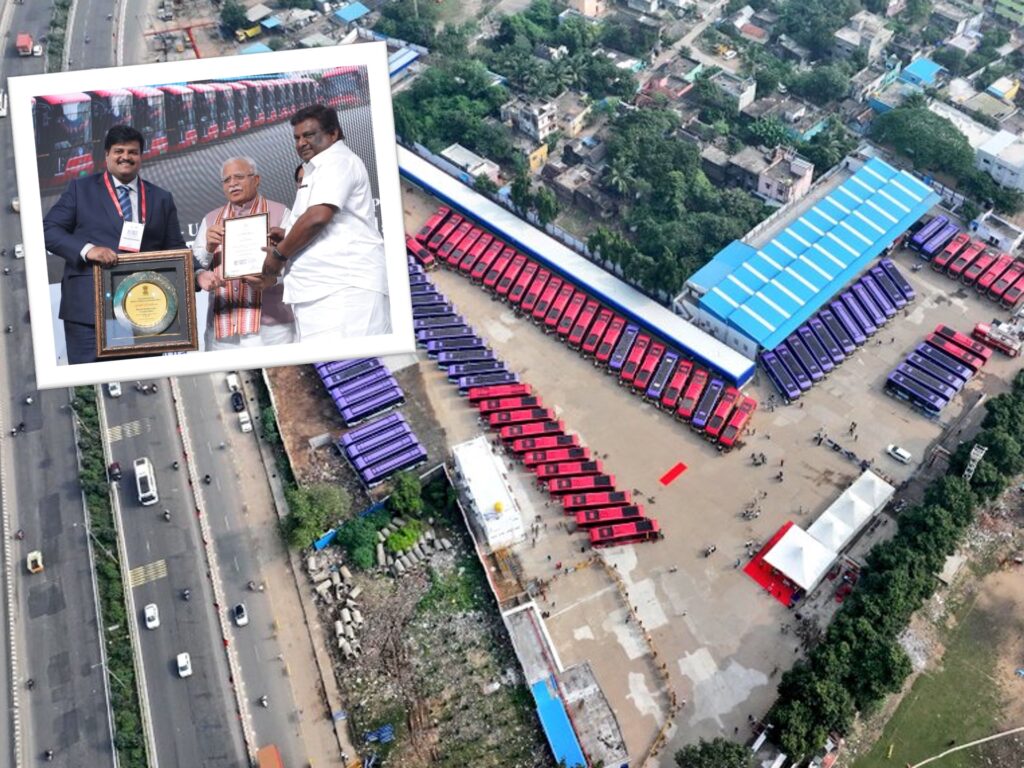
Chennai’s public transport got a major boost with 400 electric buses in 2025 – a first in the city. By next year, the city is expected to have a total of 1,250 e-buses. ITDP India partnered with MTC to support this clean mobility shift, which was recognised when MTC won India’s Best Public Transport System award at the Urban Mobility India (UMI) Conference, 2025.
4
5
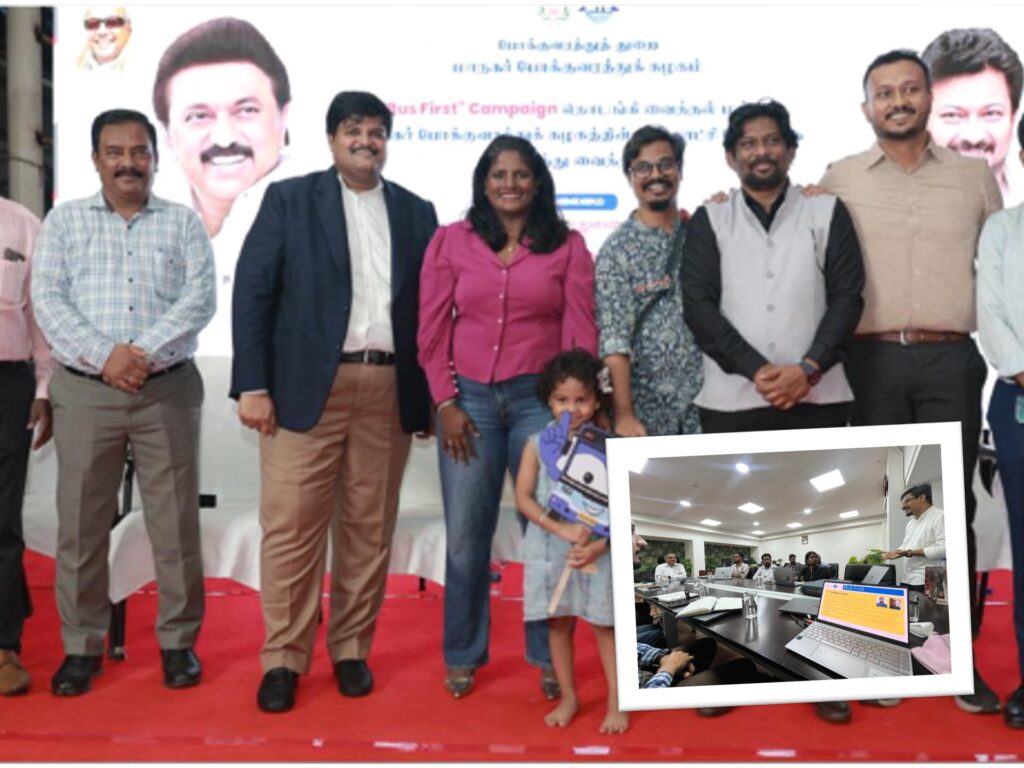
Making buses faster, cleaner, and more reliable starts with everyone! Chennai launched the “Bus First” campaign, a first-of-its-kind behaviour change initiative to nudge citizens to give way to buses. It was unveiled on November 21 by Udhayanidhi Stalin, Hon’ble Deputy Chief Minister, TN. ITDP India supported the conceptualisation and communications effort, including awareness drives in schools and colleges, creative campaigns, and appointment of brand ambassador. All this will help towards building public support for dedicated bus priority lanes.
This year marked a turning point as ITDP India’s efforts in Coimbatore began to gain momentum, building on years of groundwork. Inspired by Chennai, Coimbatore’s budget embedded sustainable mobility into city planning, and committed to revise the Street Design Guidelines and a have new Non-Motorised Transport (NMT) Action Plan. Facing over 1,000 road fatalities in 2023, the city committed Rs 2.5 crore to a Safe Routes to School (SRTS) pilot, now scaling from one corridor to 10 school streets, turning safer access for children into a citywide priority.
6
7
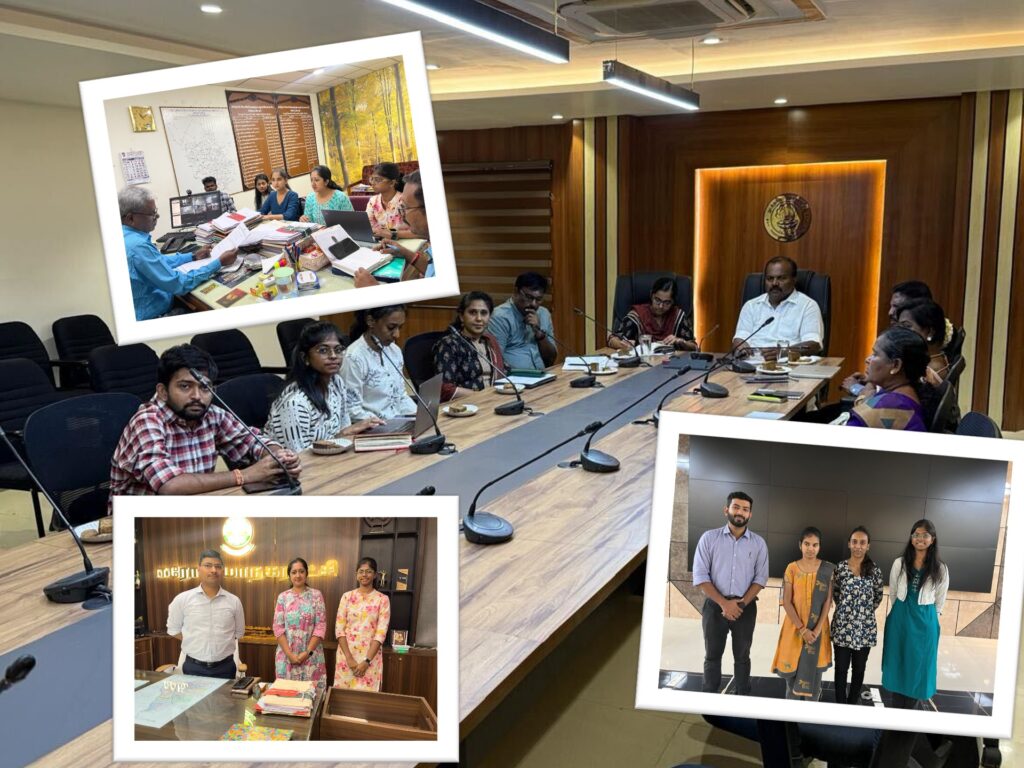
Big-city solutions don’t always work for smaller cities, and Tamil Nadu is leaning into that reality. This year, ITDP India worked closely with Erode, an emerging commercial hub, and Thoothukudi, a major port city that attracts significant EV manufacturing investments. Baseline assessments, situational analysis, and gap reports revealed different mobility needs for both cities, but one common thread emerged: both are committed to progress sustainably. These insights will feed into a People and Goods Movement report, equipping the state to shape funding and policies that extend beyond Chennai and truly serve Tamil Nadu’s diverse urban landscape.
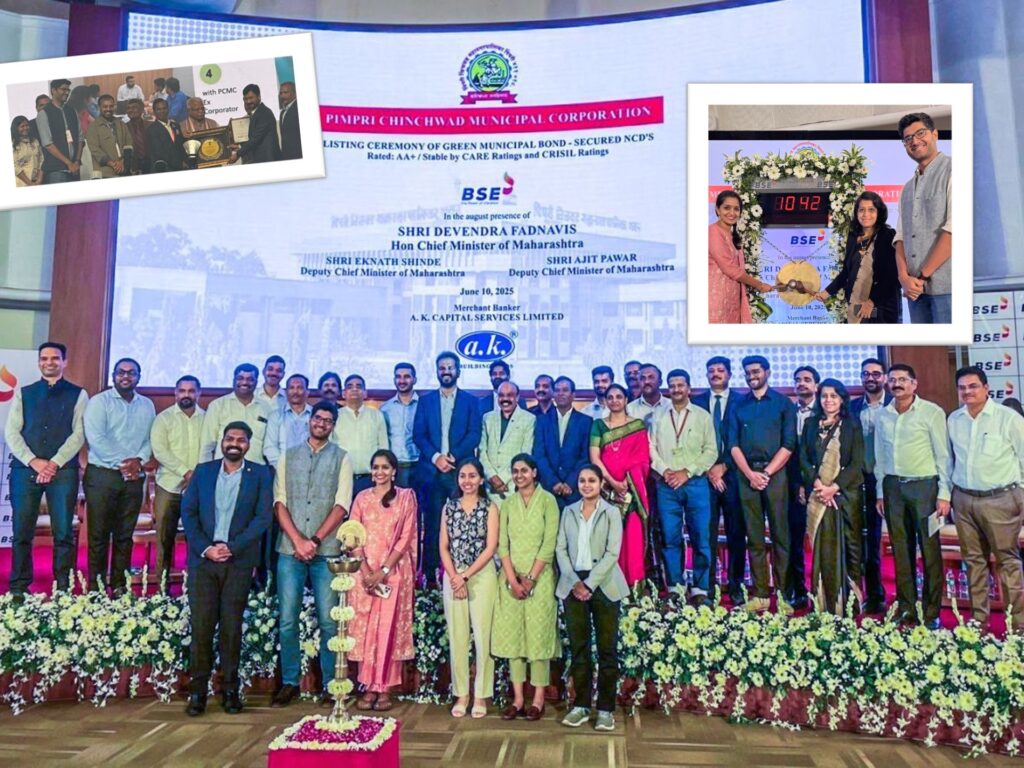
ITDP India’s work in Pimpri Chinchwad, our other lighthouse city, celebrated a landmark achievement of becoming India’s first city to issue Municipal Green Bonds for walking and cycling infrastructure, raising Rs 200 crore for people-first street transformations. This innovative financing is powering the Harit Setu and Telco Road redevelopment projects and is set to deliver continuous footpaths, shaded street networks, and safer school zones. The city also won the Most Innovative Financing Mechanism award at the UMI Conference, 2025.
8
9
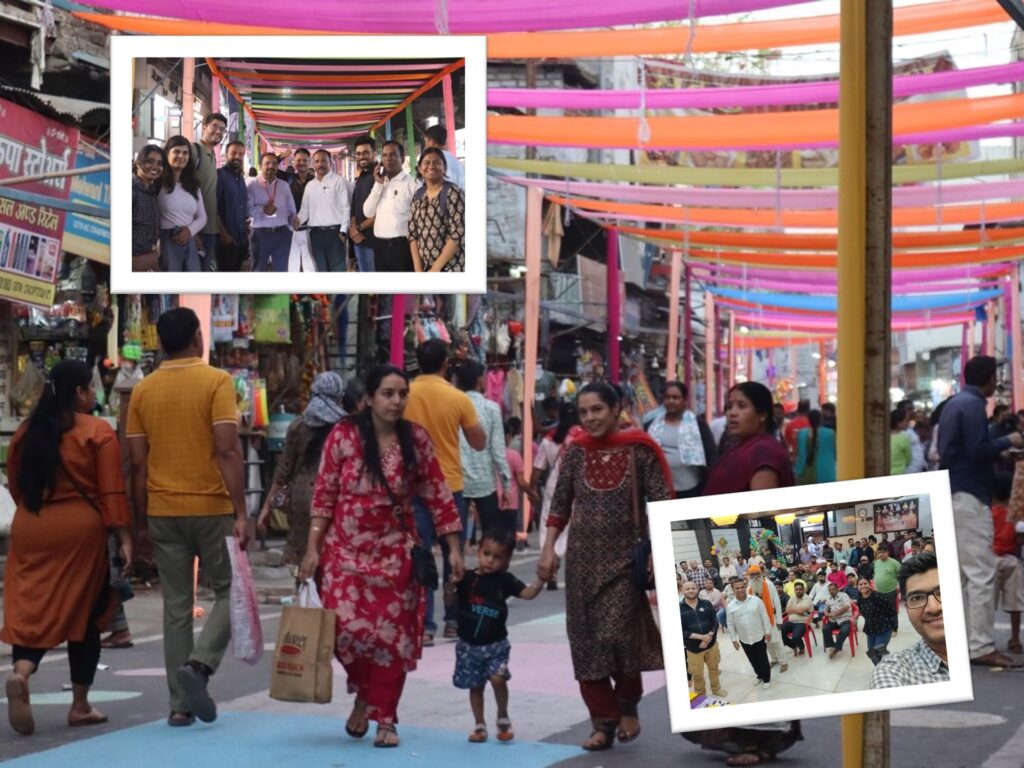
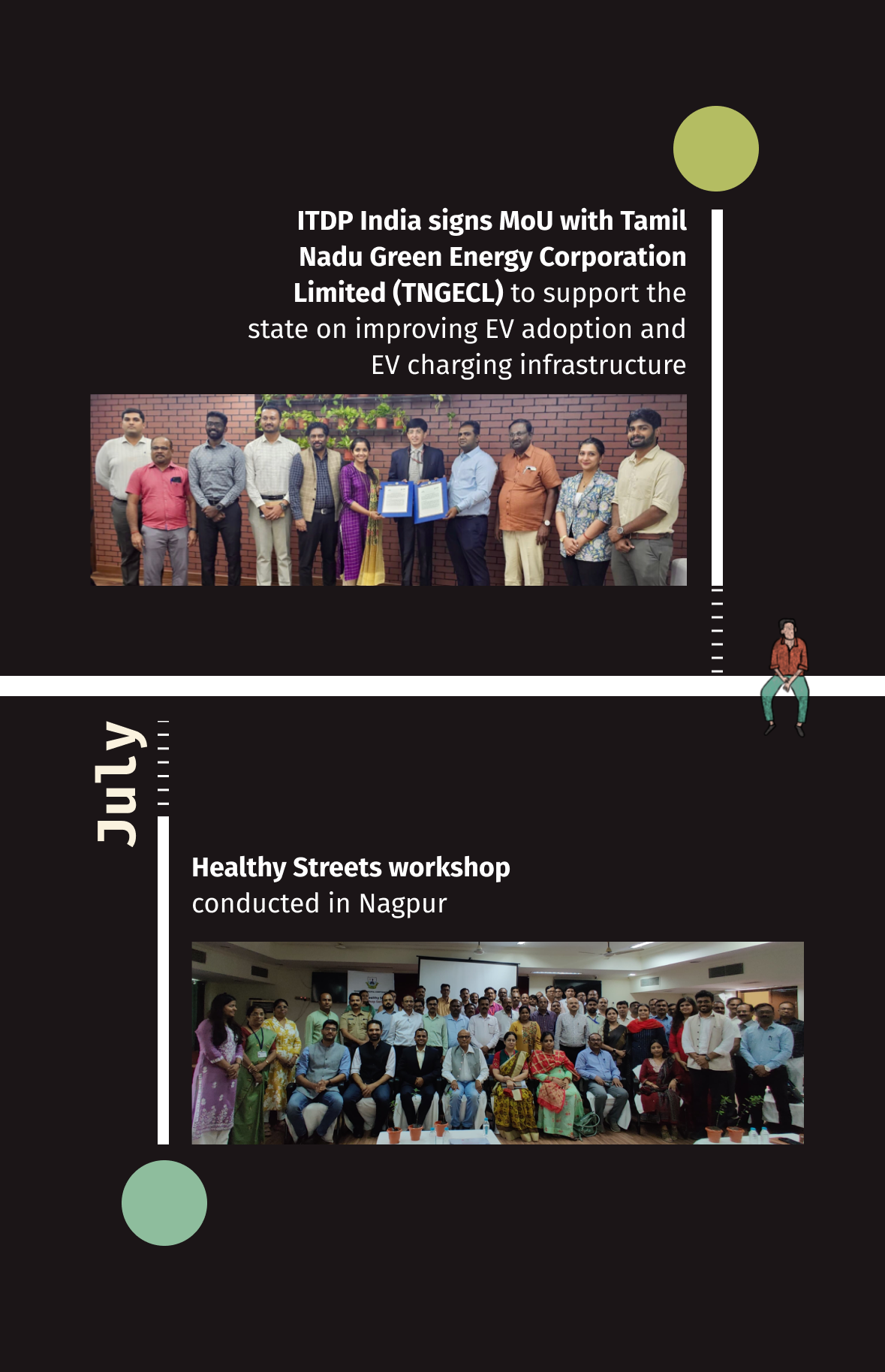
Pimpri Chinchwad is turning streets into spaces that truly belong to people! With ITDP India’s support, PCMC has implemented over 30 km of Healthy Streets, guided by community feedback and data. This year, the city also hosted its first Vehicle-Free Day, turning the core area of Pimpri market into a joyful public plaza, sparking conversations for permanent pedestrianisation. Add to this a street design workshop hosting 100+ officials from 15 cities, and PCMC’s message is clear: when streets work for people, cities everywhere start paying attention.
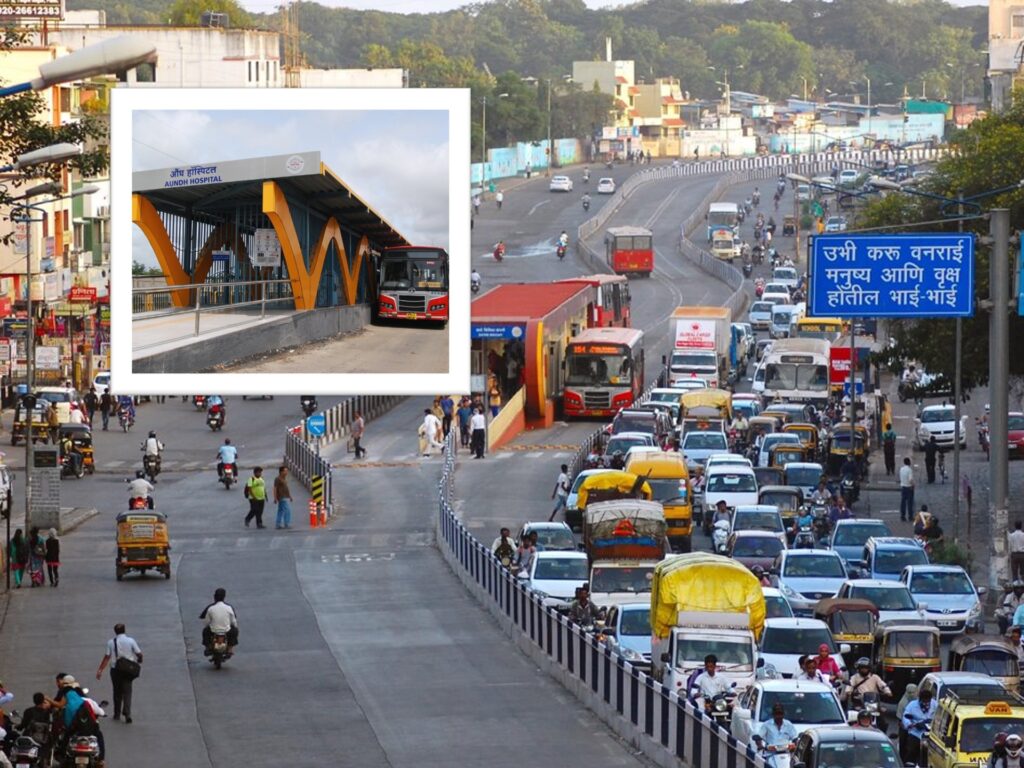
When bus lanes come under fire, data does the talking. This year, ITDP India stood firm on the PCMC’s Rainbow Bus Rapid Transit System (BRTS), countering backlash with clear outreach that made the case for retaining and strengthening the system. We supported PCMC with operational data for the Nigdi–Dapodi BRTS corridor and proposed improved bus frequencies along the critical east–west axis. The payoff? A new 5.5 km BRT corridor from Kiwale to Bhakti Shakti, piloted using ITDP India-led assessments; proof that better buses win when cities stay the course.
10
11
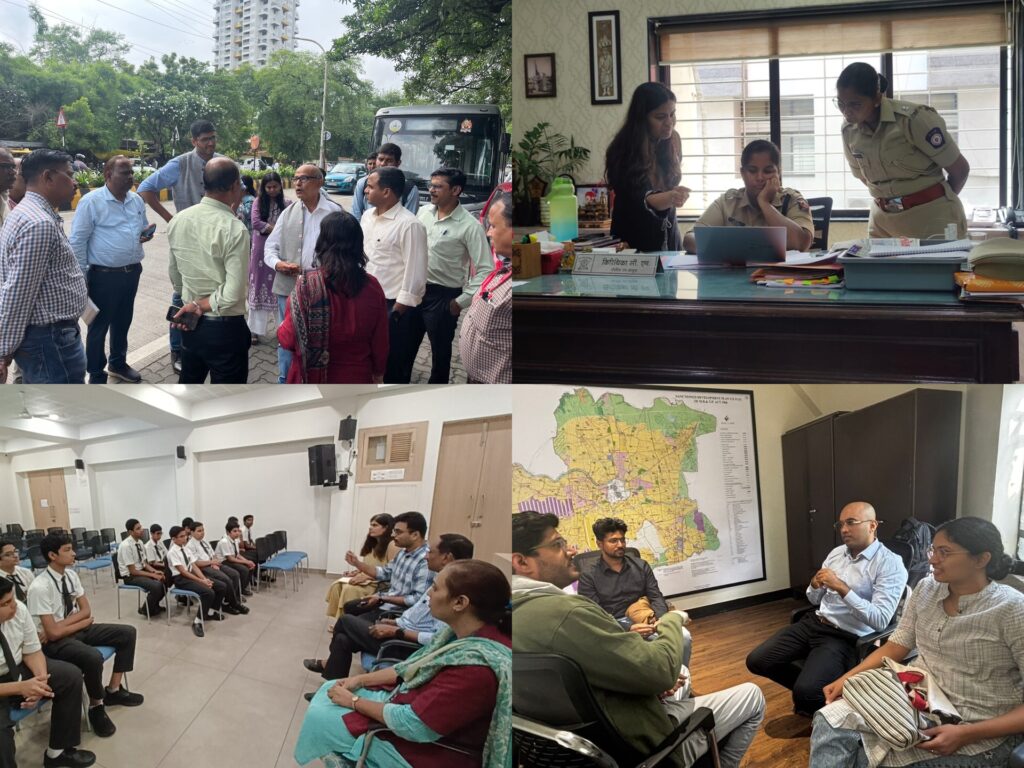
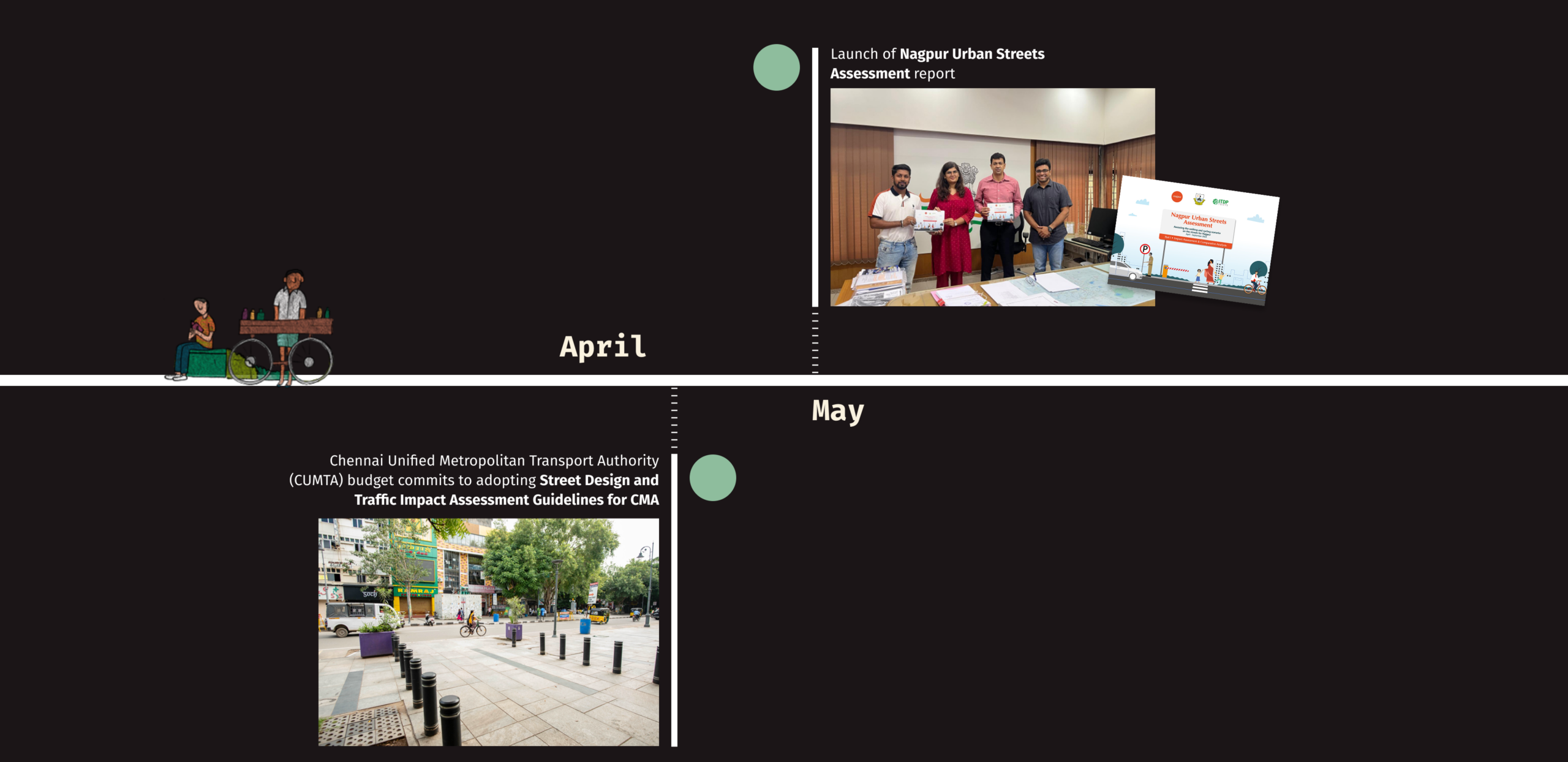
Turns out, Tier 2 cities have a lot to say, and Nagpur and Nashik are saying it loud and clear. This year, ITDP India expanded work in Maharashtra with the Nagpur Urban Streets Assessment, digging deep into how streets actually work for people who walk and cycle out of necessity. The findings, along with citizen surveys, are shaping the city’s move toward a Healthy Streets Policy. Alongside this, Nashik joined the journey, starting with pre-policy citizen surveys. The insights will feed into Nashik’s first-ever NMT Policy, proving that people-first mobility is no longer a “Tier 1 city only” conversation.
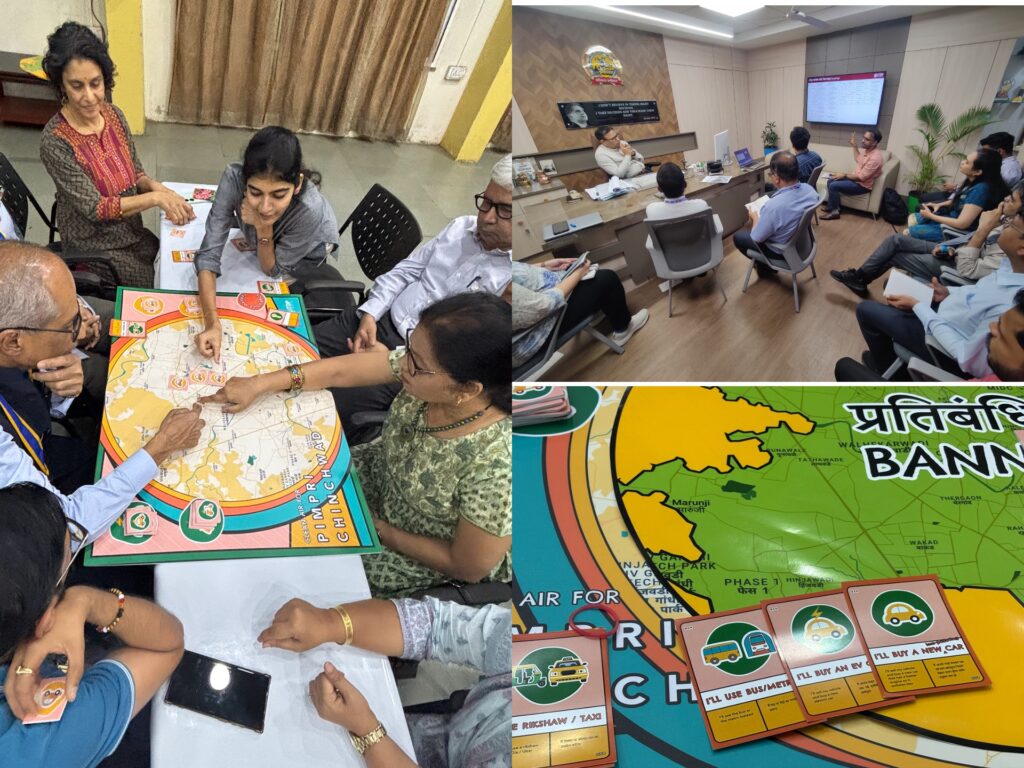
What if your daily commute came with a pollution price tag, or no polluting vehicles at all? That question sparked fun yet powerful conversations around clean air and Low Emission Zones (LEZ) in Pimpri Chinchwad and Pune. Through gamified focus group discussions in PCMC, the verdict was clear: pollution charge will act as a deterrent for citizens. To strengthen internal capacity, the city also hosted a five-day LEZ workshop with Transport for London (TfL), supported by the British High Commission. It focussed on the legal frameworks, data, technology, and public communication needed for a successful LEZ.
12
13
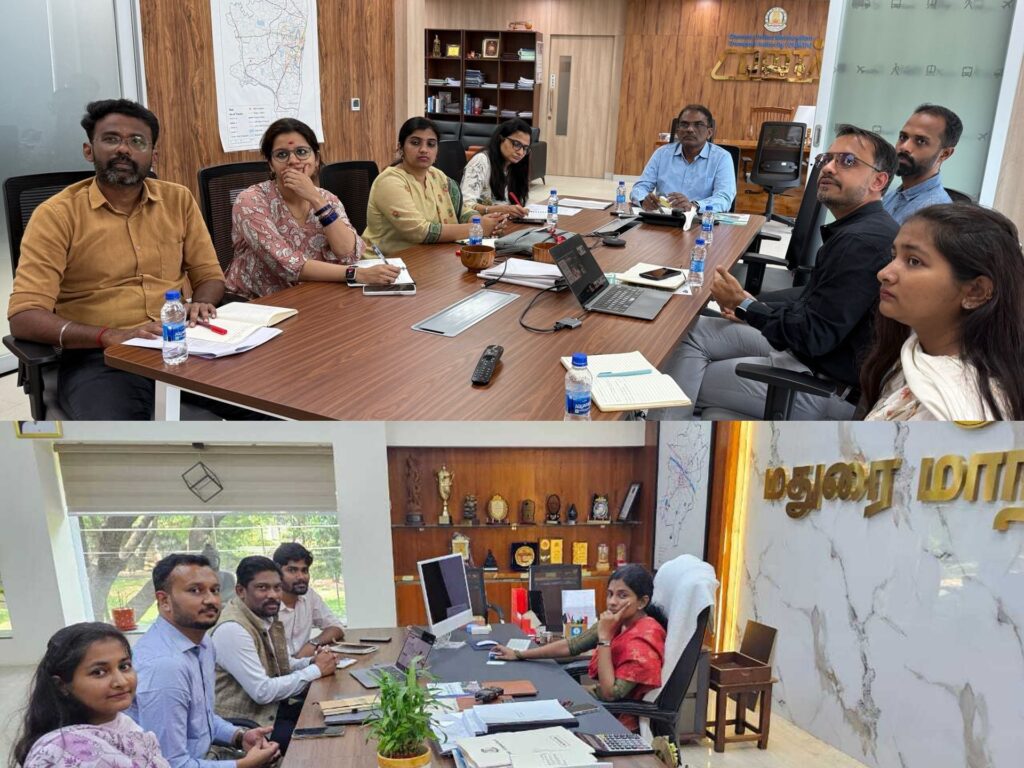
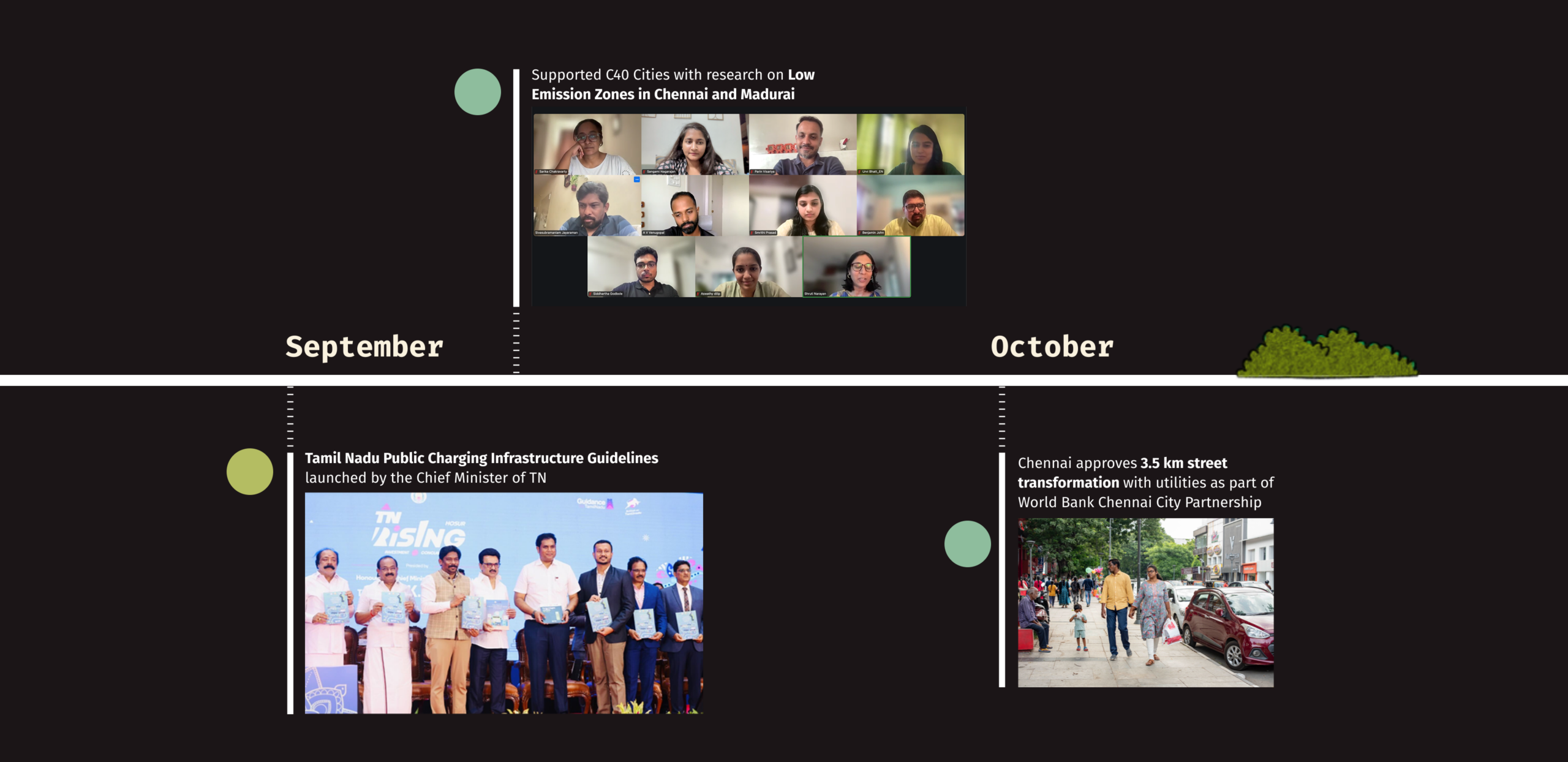
Tamil Nadu kicked off its Low Emission Zone (LEZ) journey with a sharp, data-first lens. A preliminary study, in collaboration with C40 Cities, unpacked the air pollution and vehicular emissions data in Chennai and Madurai. A method was developed to identify priority zones to discourage the use of high polluting vehicles. Conversations with multiple agencies showed that for Tier 2 cities like Madurai, state government support is crucial. Madurai stepping up was a big win, unlocking the potential of National Clean Air Programme (NCAP) funding.
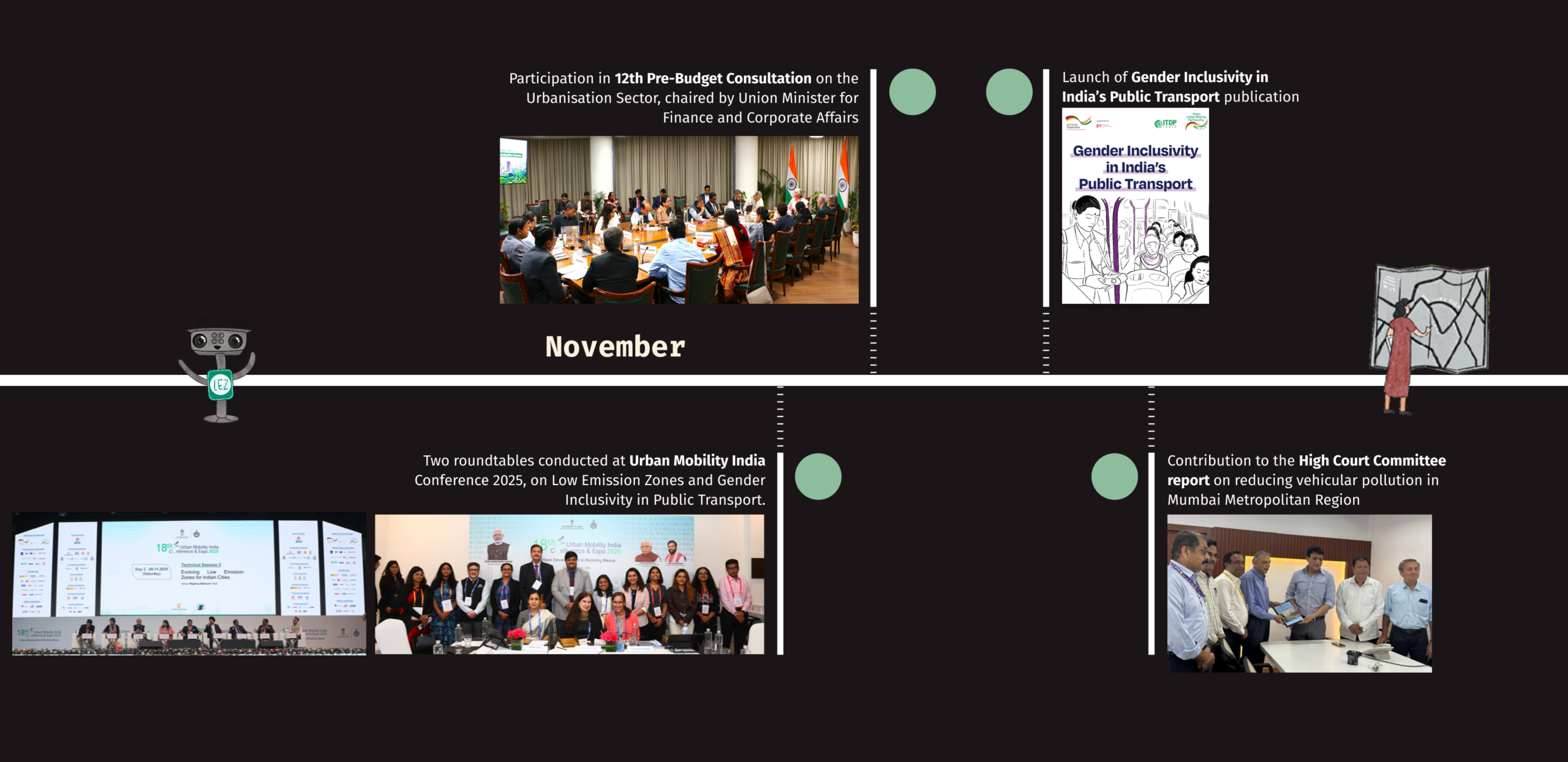
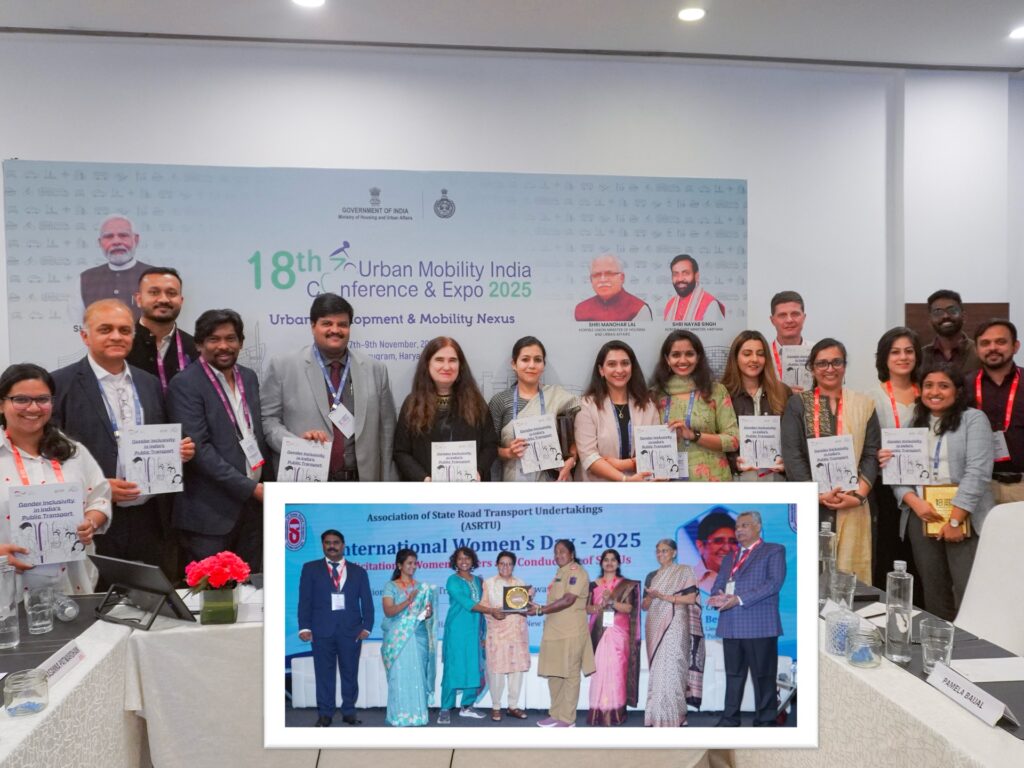
Who keeps our cities moving, and who gets left behind in the process? ITDP India’s gender-focused work put that question front and centre this year. Through the Gender Inclusivity in India’s Public Transport report, developed with GIZ India, we found that women are underrepresented in the public transport workforce with just 0.16% hired as bus drivers, while 23% of women said they would use public transport more if it felt safer. From launching the report and co-hosting a national panel at UMI to supporting ASRTU’s International Women’s Day, ITDP India is pushing cities to move beyond “gender-neutral” systems, and towards transport that truly works for women, with women.
14
Electrify Urban Transport Systems
Through regulatory reforms, pilot projects, and partnerships with city and state agencies, ITDP India is powering the transition to electric vehicles – especially buses – while creating accessible, city-wide charging networks. Using public transport is key to moving around the city but it’s just as important that this transport is clean. Check out the systems we supported with electrification this year!
Through regulatory reforms, pilot projects, and partnerships with city and state agencies, ITDP India is powering the transition to electric vehicles – especially buses – while creating accessible, city-wide charging networks. Using public transport is key to moving around the city but it’s just as important that this transport is clean. Check out the systems we supported with electrification this year!
Through regulatory reforms, pilot projects, and partnerships with city and state agencies, ITDP India is powering the transition to electric vehicles – especially buses. At the same time we are also looking into creating accessible, city-wide charging networks. Why? Using public transport is key to moving around the city but it’s just as important that this mode of transport is clean. Check out the projects and systems that we supported with electrification this year!
15
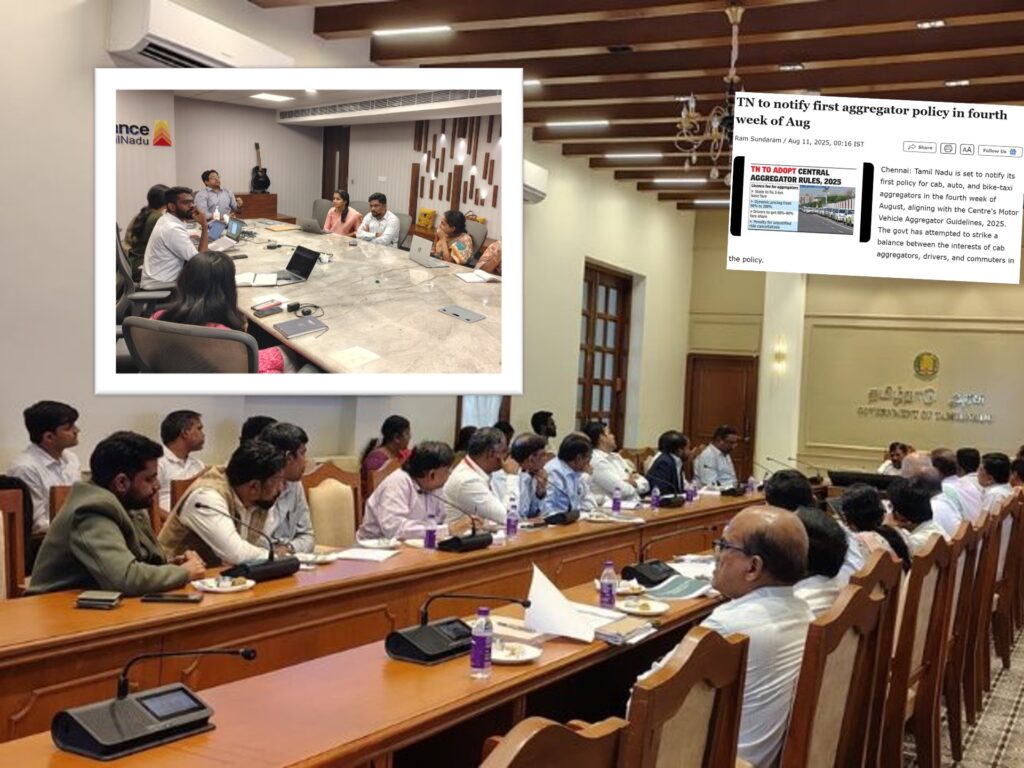
Clean mobility isn’t just about new vehicles; it’s about rewriting the rules of the system. This year, ITDP India supported Guidance Tamil Nadu, to prepare three critical regulatory reforms shaping the state’s EV ecosystem. The three policies are: State Vehicle Scrappage Policy, approved in September 2025; Circular Economy Policy poised to recycle EV batteries annually by 2030, and a proposed Demand Aggregator Policy aimed to steer commercial fleets toward electrification.
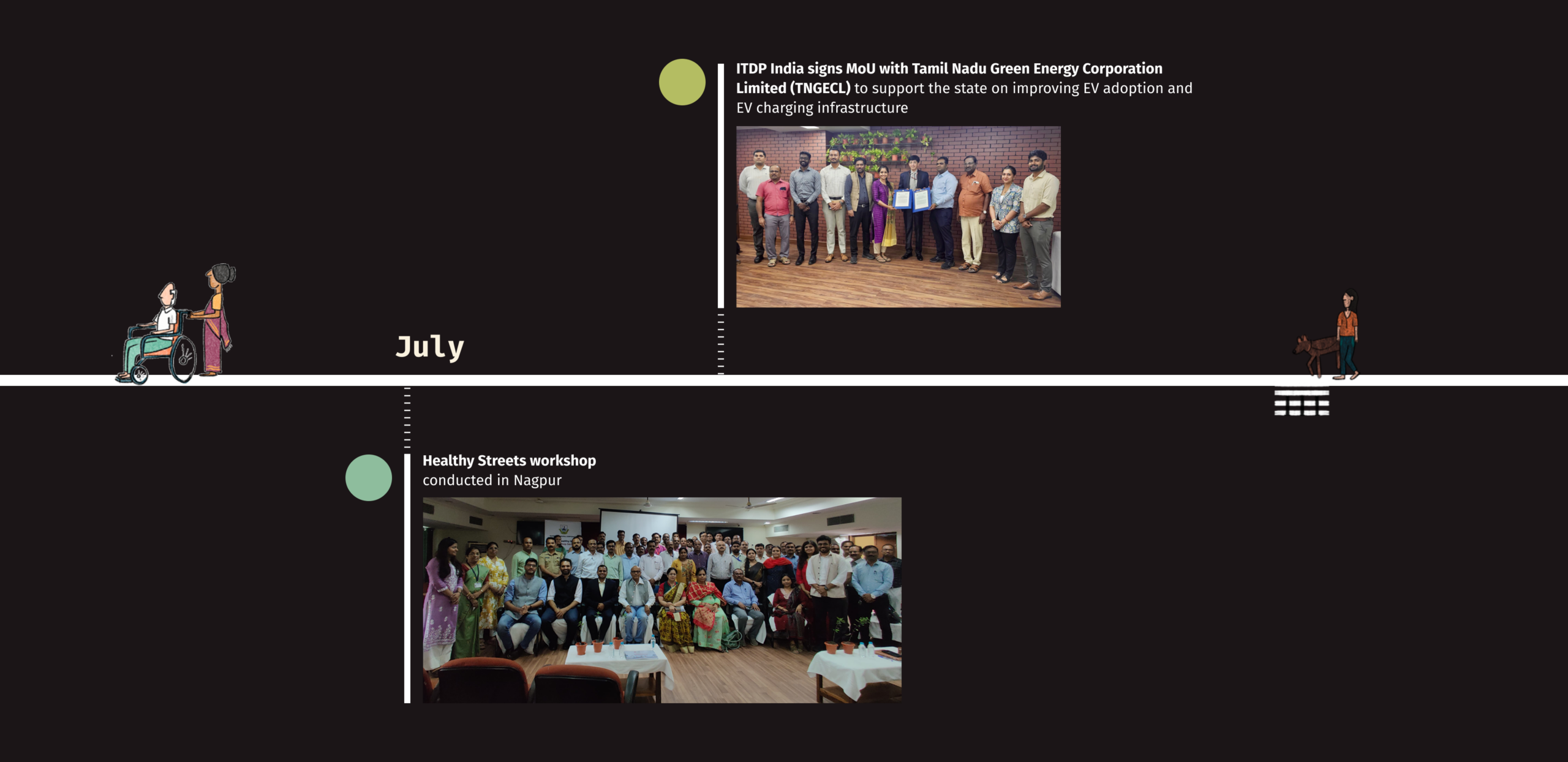
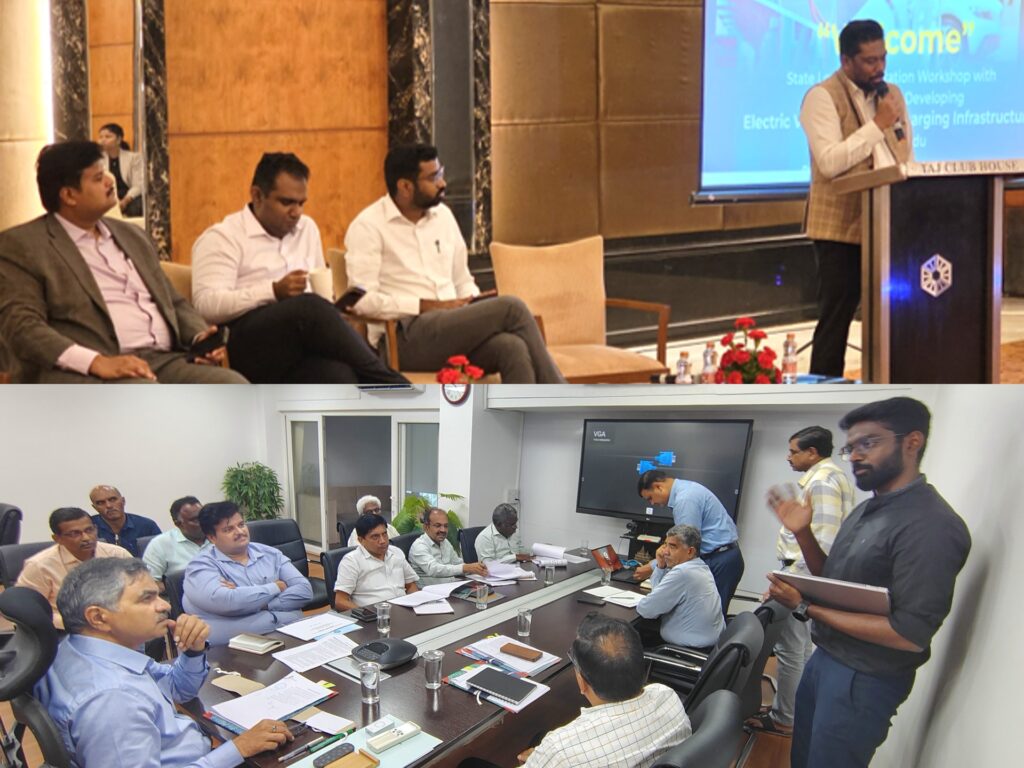
Powering up the EV transition takes more than just plugs; it takes coordination, land, and clear rules. The Public Charging Infrastructure Programme in Tamil Nadu, supported by ITDP India is doing exactly that. The Tamil Nadu Public Charging Infrastructure Guidelines were launched by MK Stalin, Hon’ble CM of TN. Riding on the momentum of the PM E-Drive scheme, ITDP India is working with Tamil Nadu Mobility and Logistics Corporation Limited (TNMLC) and TNGECL to unlock Rs 2,000 crore for charging rollout, aggregate government land, and ease the challenges of Charge Point Operator (CPOs). A state-level roundtable was also organised that prompted action by the Chief Secretary to initiate city visits, build capacity, create Standard Operating Procedures, and identify public land parcels.
16
17
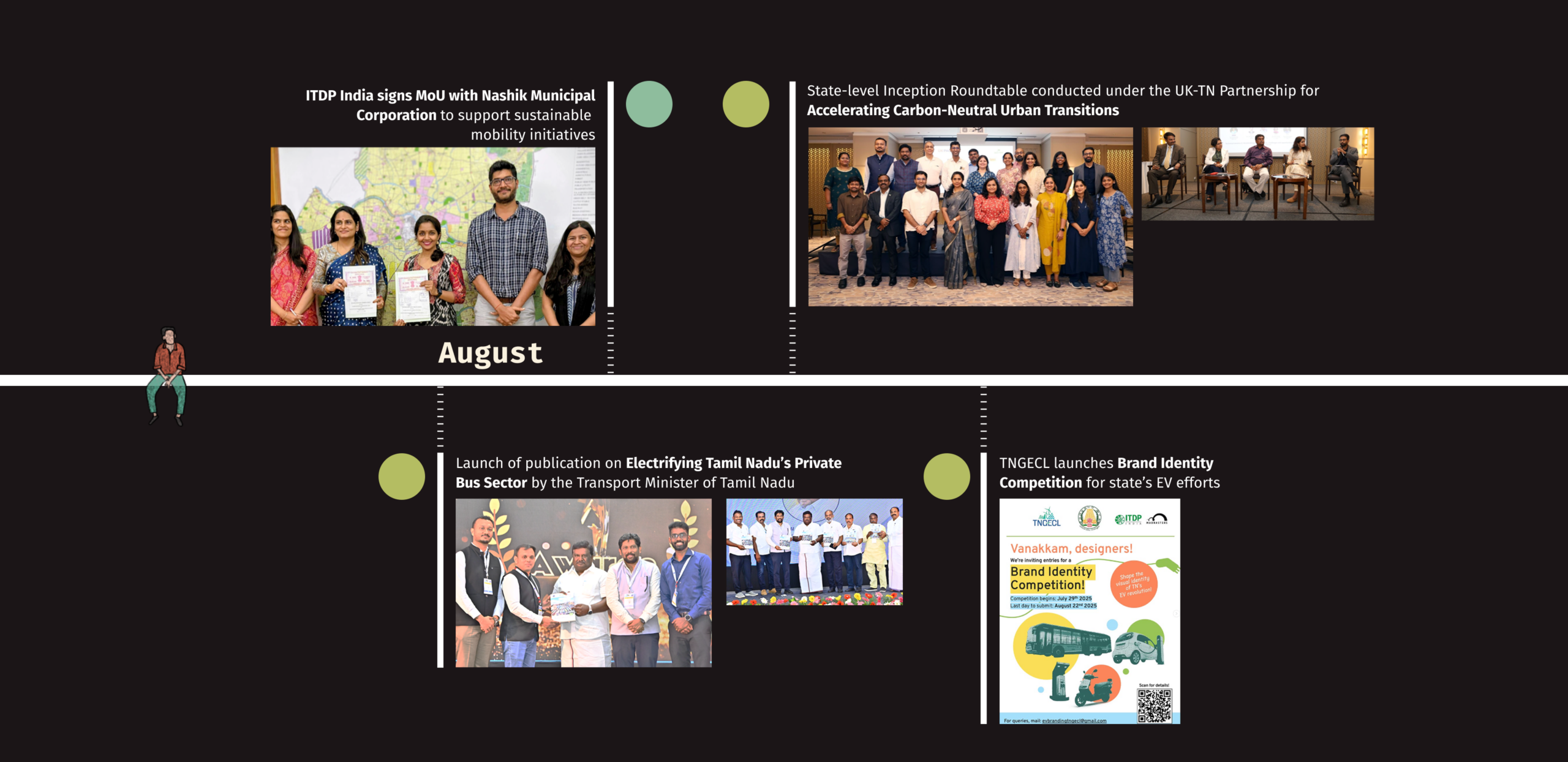
Tamil Nadu is making electric mobility visible, exciting, and accessible! ITDP India, in collaboration with Tamil Nadu Green Energy Corporation Limited (TNGECL) and Madrasters, launched the TN EV Brand Identity Competition to capture the energy and ambition of the state’s EV future. Over 145 entries from designers, students, and professionals brought fresh perspectives on how EVs can connect with citizens, landowners, and CPOs. The winning design will guide the branding for TNGECL’s digital platforms and communications. Building awareness, trust, and enthusiasm for EV is as much about engagement as technology.
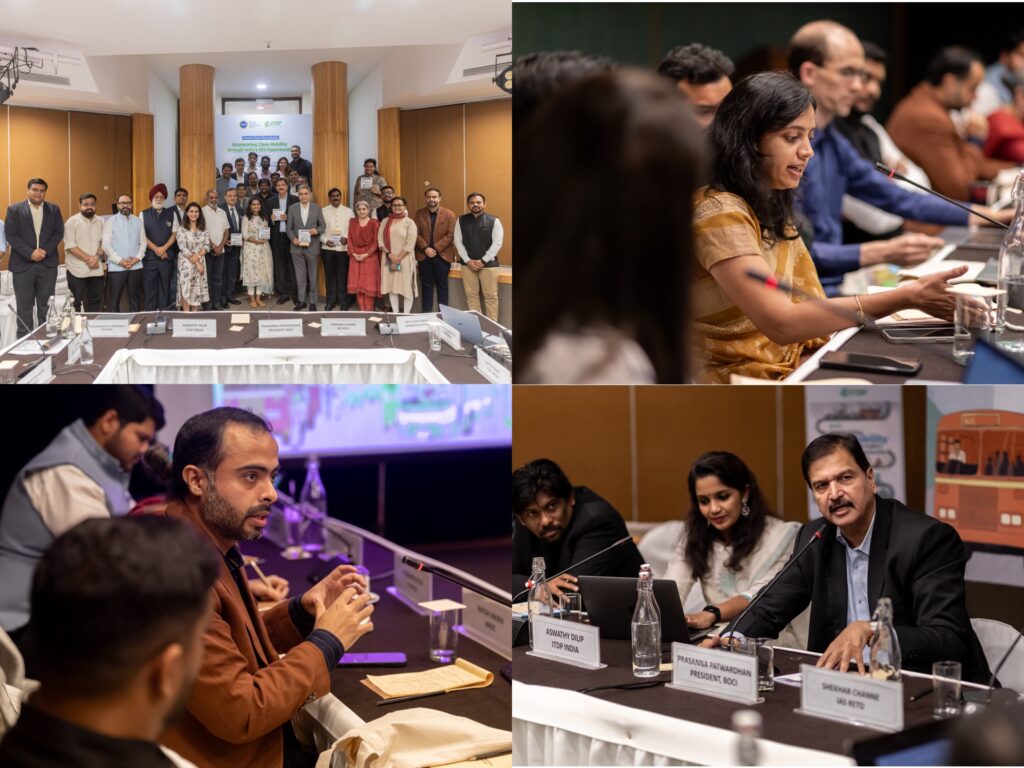
India aims to shift gears toward cleaner mobility, but the supply isn’t quite keeping up with the ambition. The team has been working on a framework for Supply Side Measures, and we recently launched Accelerating Clean Mobility through India’s ZEV Opportunity at a closed-door roundtable in New Delhi in partnership with the Bus and Car Operators Confederation of India (BOCI). The discussion brought together Original Equipment Manufacturers (OEMs), state transport undertakings, private operators, and industry experts to reflect on what’s working and what needs attention to scale electric buses.
18
19
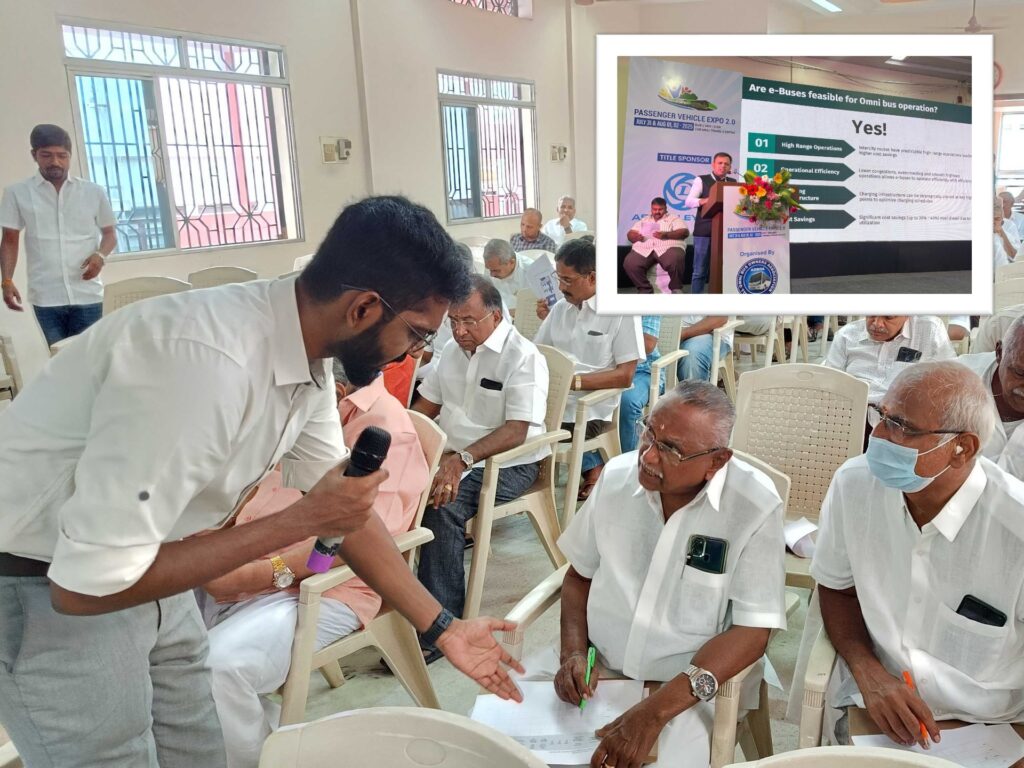
Private buses are getting an electric upgrade, and Tamil Nadu is listening. At the Passenger Vehicle Expo 2025, ITDP India supported the launch of the publication Accelerating Sustainability: Electrifying Tamil Nadu’s Private Bus Sector. This launch was in the presence of SS Sivasankar, Hon’ble Minister for Transport and Electricity, TN, bringing the spotlight on the need to electrify private stage carriage buses. With 48 lakh daily users and massive fuel and emissions savings at stake, the message is evident: the private bus sector can play a big role in Tamil Nadu’s clean mobility shift.
Secure Funding at Scale
Recognising the urgency of the climate crisis, ITDP India is engaging at the state and national level. The priority is financing, policy, and creation of guidelines to unlock transformation at scale.
Recognising the urgency of the climate crisis, ITDP India is engaging at the state and national level. The priority is financing, policy, and creation of guidelines to unlock transformation at scale.
Recognising the urgency of the climate crisis, ITDP India is engaging not just at the state but also the national level. The priority is financing, policy, and creation of guidelines to unlock transformation at scale.
20
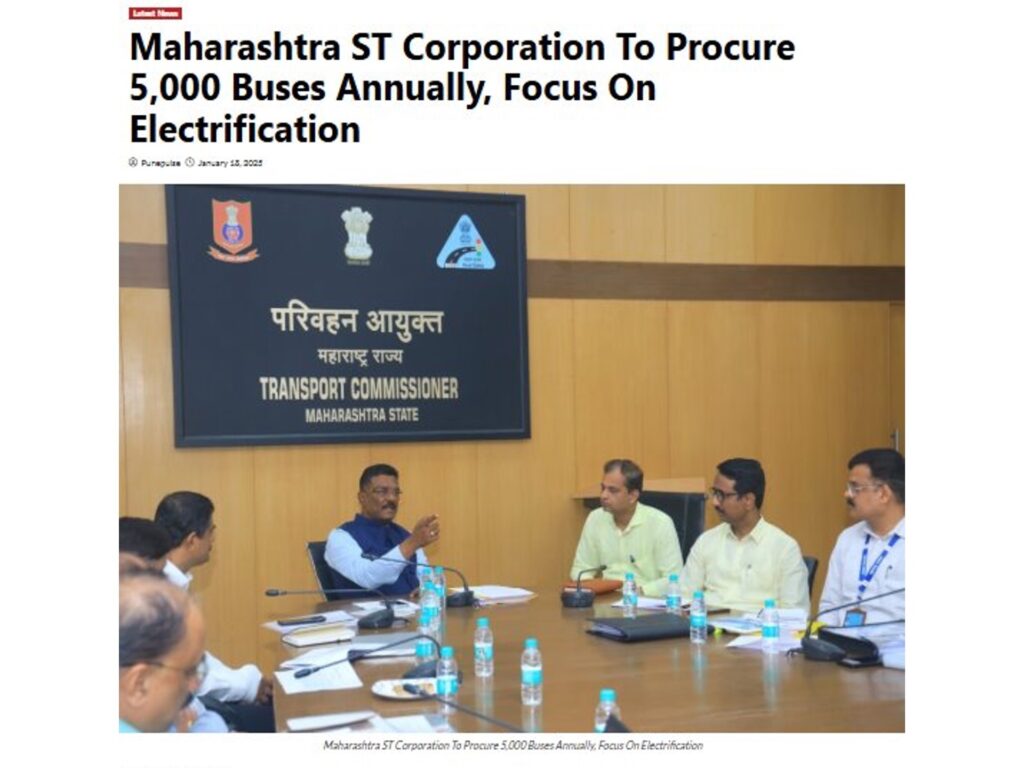
Maharashtra goes big on clean mobility, which is scaling up faster this year. The Mahabus Programme became a turning point as ITDP India supported the state in unlocking financing for bus expansion. A proposal presented to Ajit Pawar, Hon’ble Deputy Chief Minister of Maharashtra, led to the procurement of 1,000 buses for PMPML. This was backed by a 50% funding from the Pune Metropolitan Region Development Authority and municipal corporations. Parallel media engagement helped trigger a much larger commitment – 25,000 buses for the Maharashtra State Road Transport Corporation, which will be rolled out at 5,000 buses a year, setting the pace for cleaner, people-first transport across 44 cities of the state.
A Few Milestones Beyond the Lanes
21
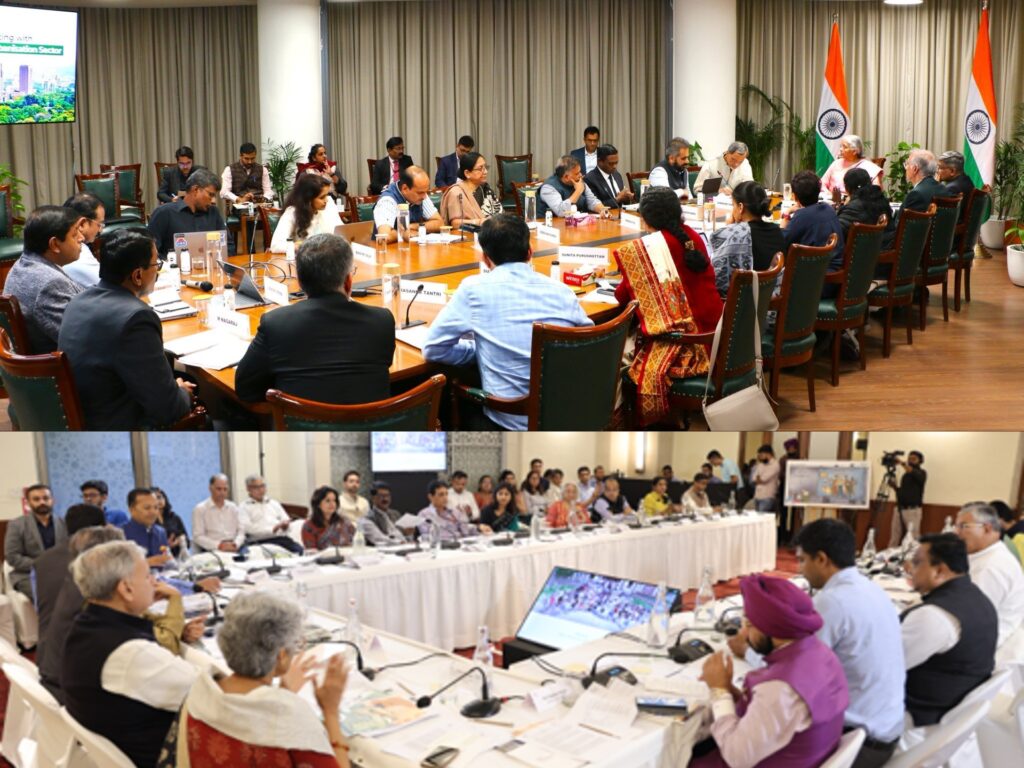
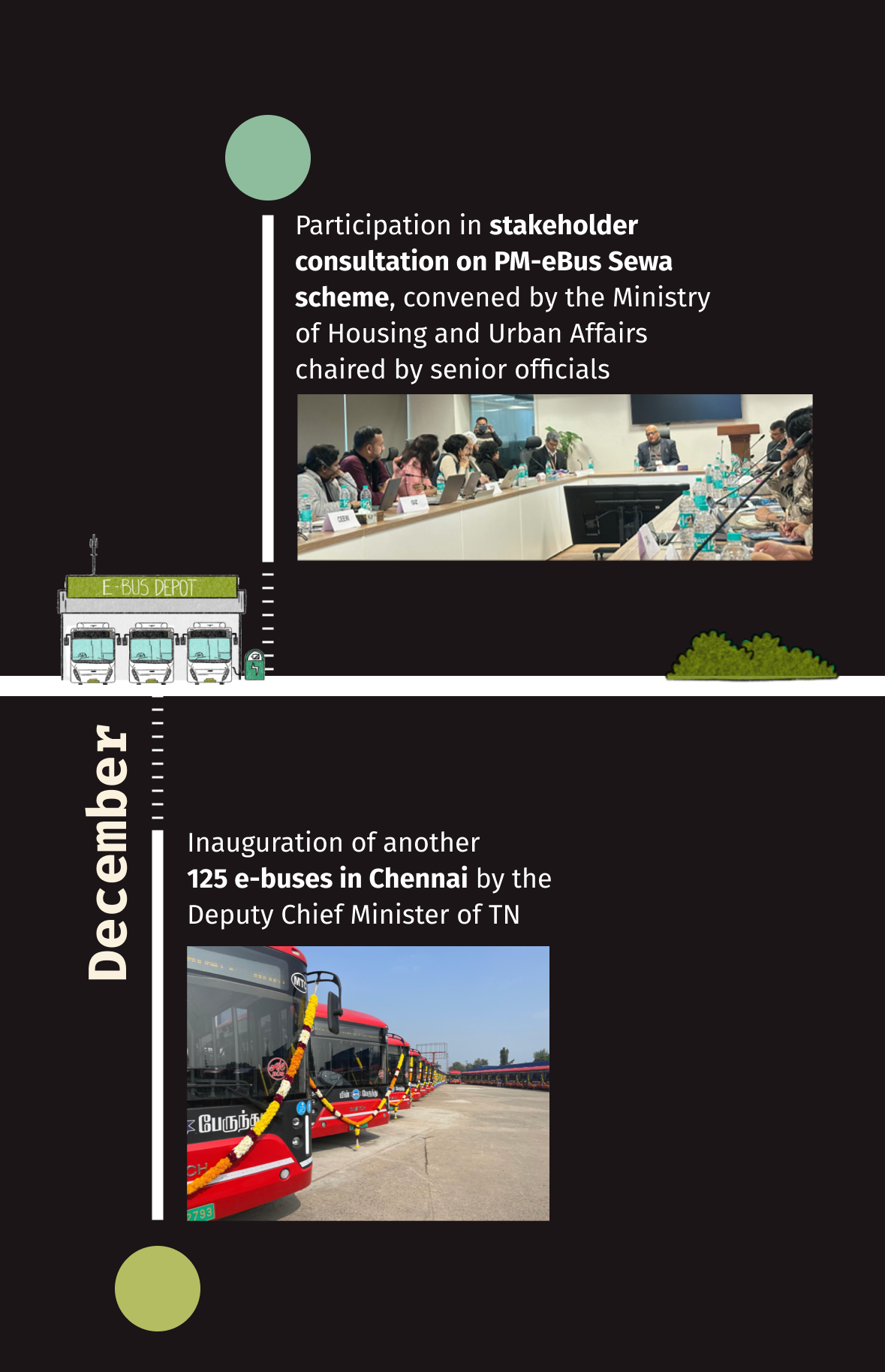
Credibility opens doors; and this year, it took us straight into rooms that shape national decisions. ITDP India was invited to high-level discussions. The first discussion was at the CEEW roundtable hosted by Dr Shashi Tharoor, Hon’ble Member of Parliament on the need for clean air. The second discussion was at the Finance Ministry’s Pre-Budget Consultation on Urbanisation, spearheaded by Nirmala Sitharaman, Hon’ble Union Minister for Finance and Corporate Affairs, where we shared evidence-based insights on cleaner buses, safer streets, and reducing polluting vehicles. In the third discussion, we shared insights at the stakeholder consultation on PM-eBus Sewa scheme, convened by Ministry of Housing and Urban Affairs, chaired by senior officials.
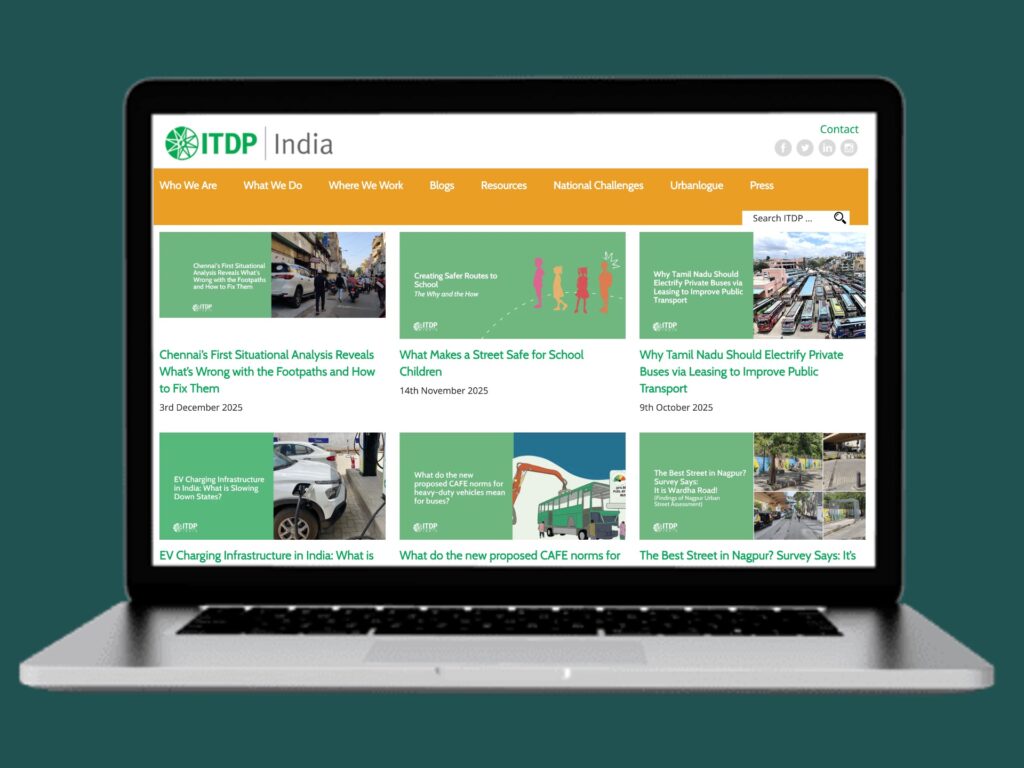
The content engine didn’t just run this year – it sprinted! Through our communications outreach work, ITDP India rolled out 19 blogs unpacking the work we do, 3 op-eds shaping public conversations, 15 press notes keeping momentum visible, and 15 original videos bringing on-ground change to life. And of course, 12 newsletters and numerous information packed social media posts, that stitched it all together. For regular updates subscribe to our newsletters here!
22
23
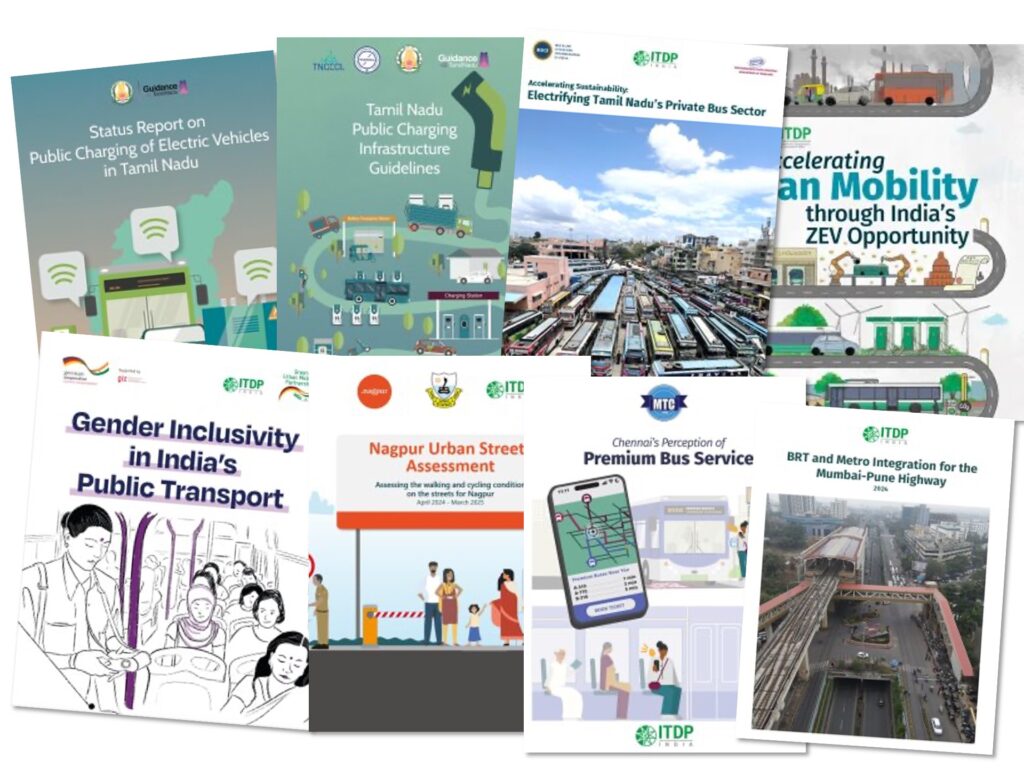
Turning pages into impact! ITDP India curated nine publications this year. Each release blends high quality and thorough insight with clarity: exploring gender and public transport; BRT and metro integration; perception of premium bus service; zero emission vehicles; public charging infrastructure; private bus electrification; street assessments in Nagpur and Chennai.
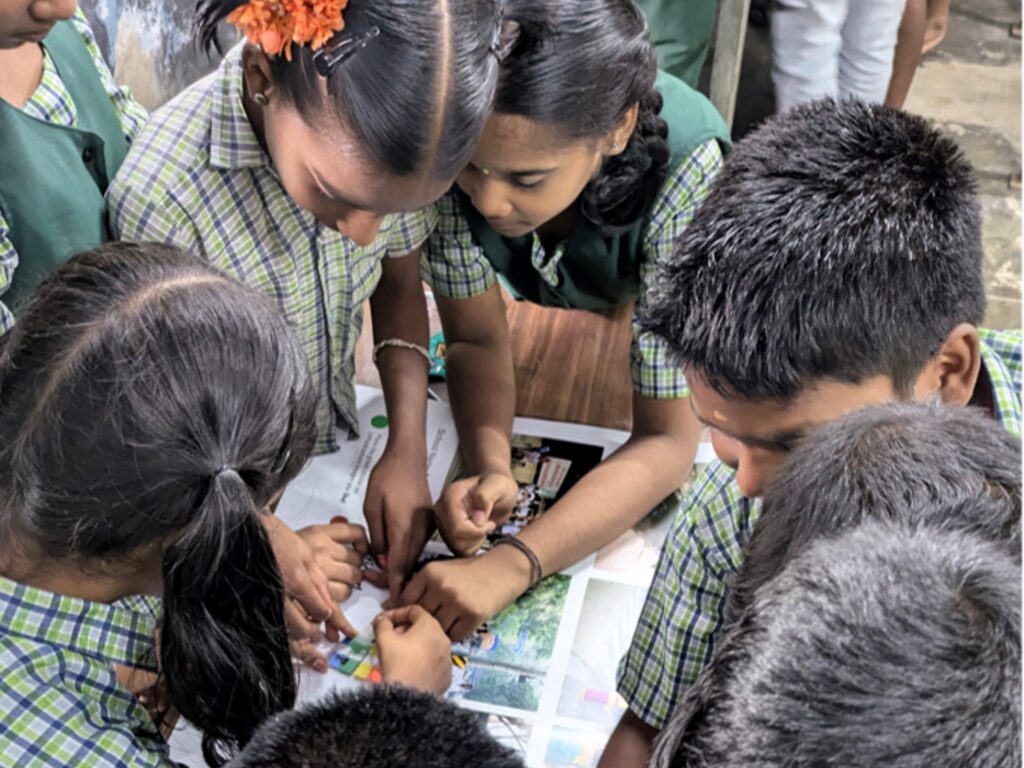
Getting everyone in the game, literally! ITDP India shook up stakeholder engagement this year with fun yet powerful engagement tools. From immersive focus group discussions and gamified sessions for Low Emission Zones to quirky zines that got kids thinking about streets and transport, we turned consultations into conversations. Because when engagement is fun, everyone’s ideas move forward.
24

25
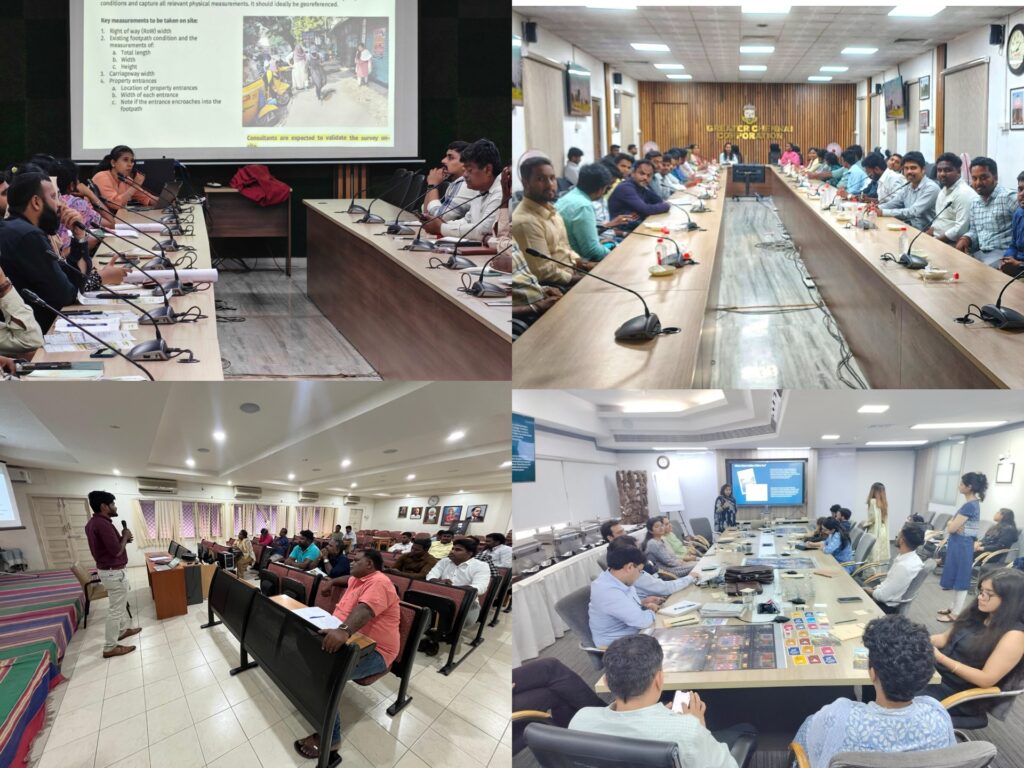
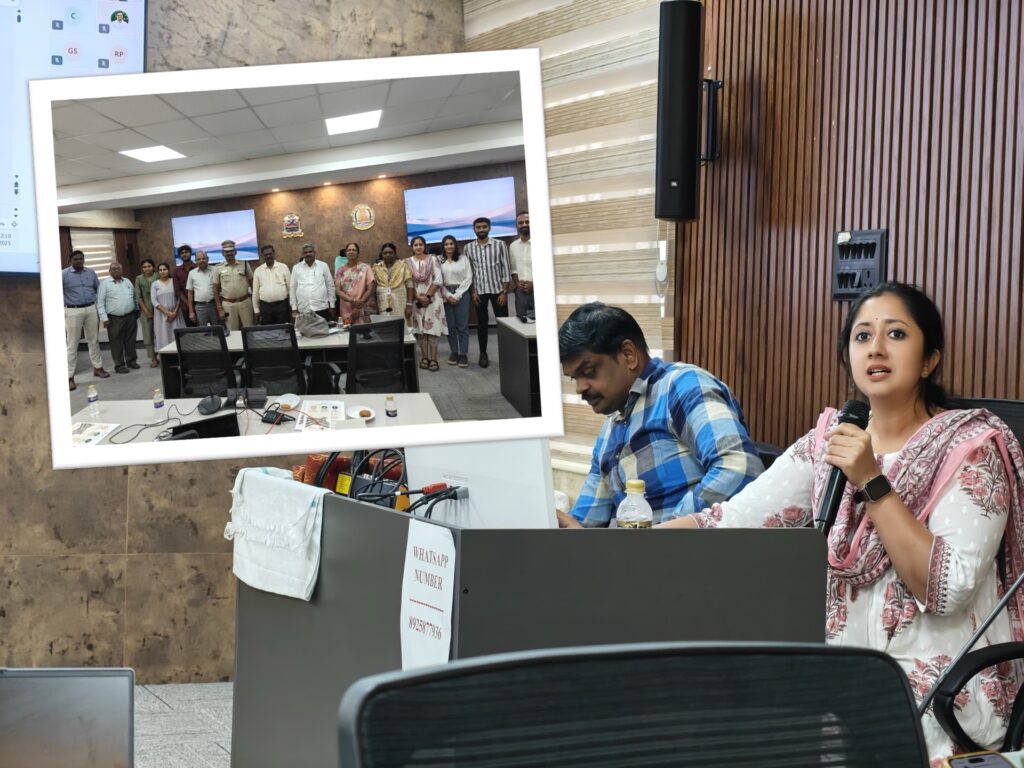
Beyond supporting governments in policy design and on-ground implementation, ITDP India is building the capacity of the officials who make it all happen. This year, around 1,000 engineers and officers were trained in street design, parking management, and planning EV charging infrastructure across Coimbatore, Madurai, Chennai, Pimpri Chinchwad, Nagpur, as well as DANICS officers (Delhi, Andaman and Nicobar Islands, Lakshadweep, Daman and Diu, Dadra and Nagar Haveli Civil Service). By empowering more people with skills and knowledge, we aim to enable a wider network of changemakers.
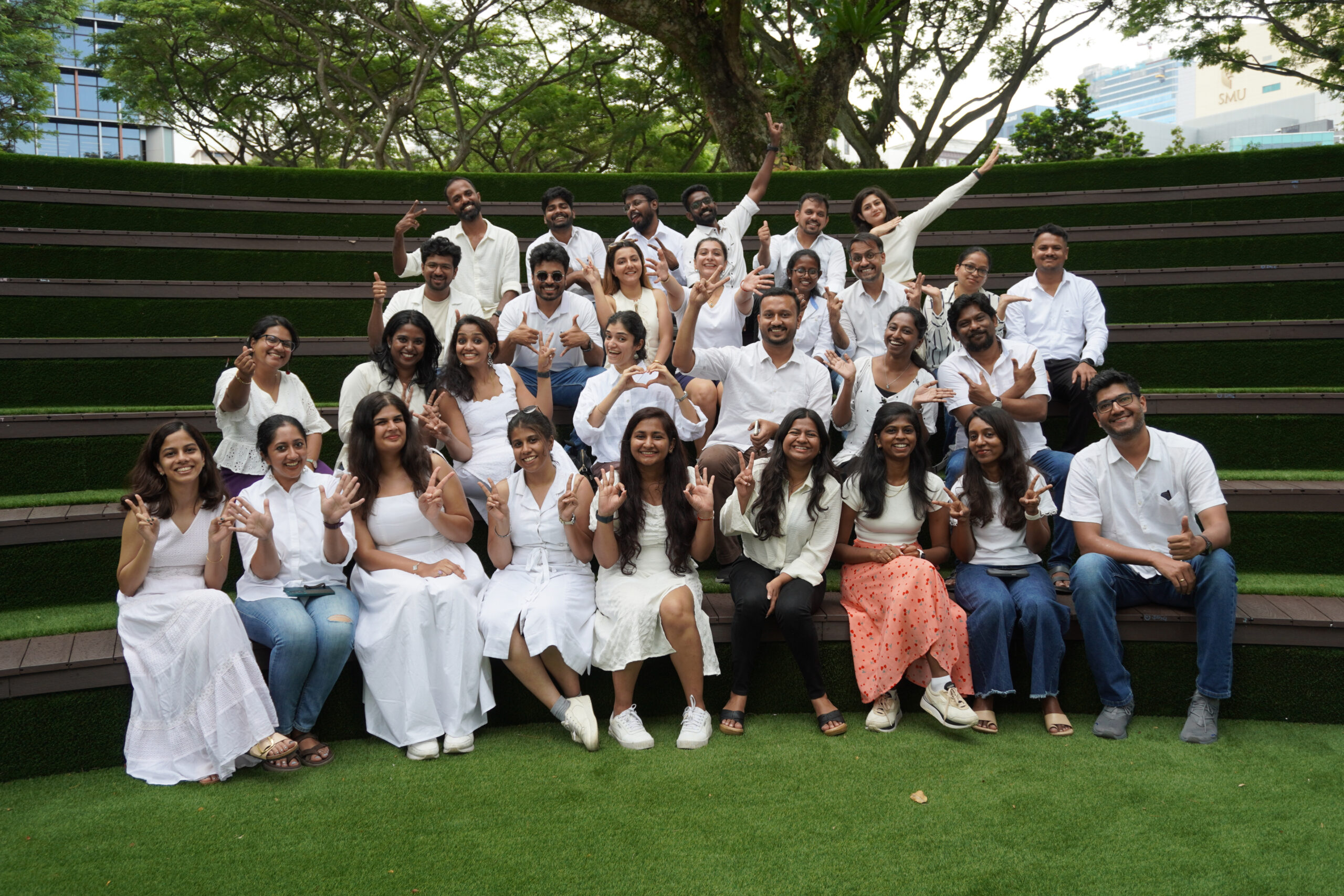
The ITDP India Team Behind the Scenes...
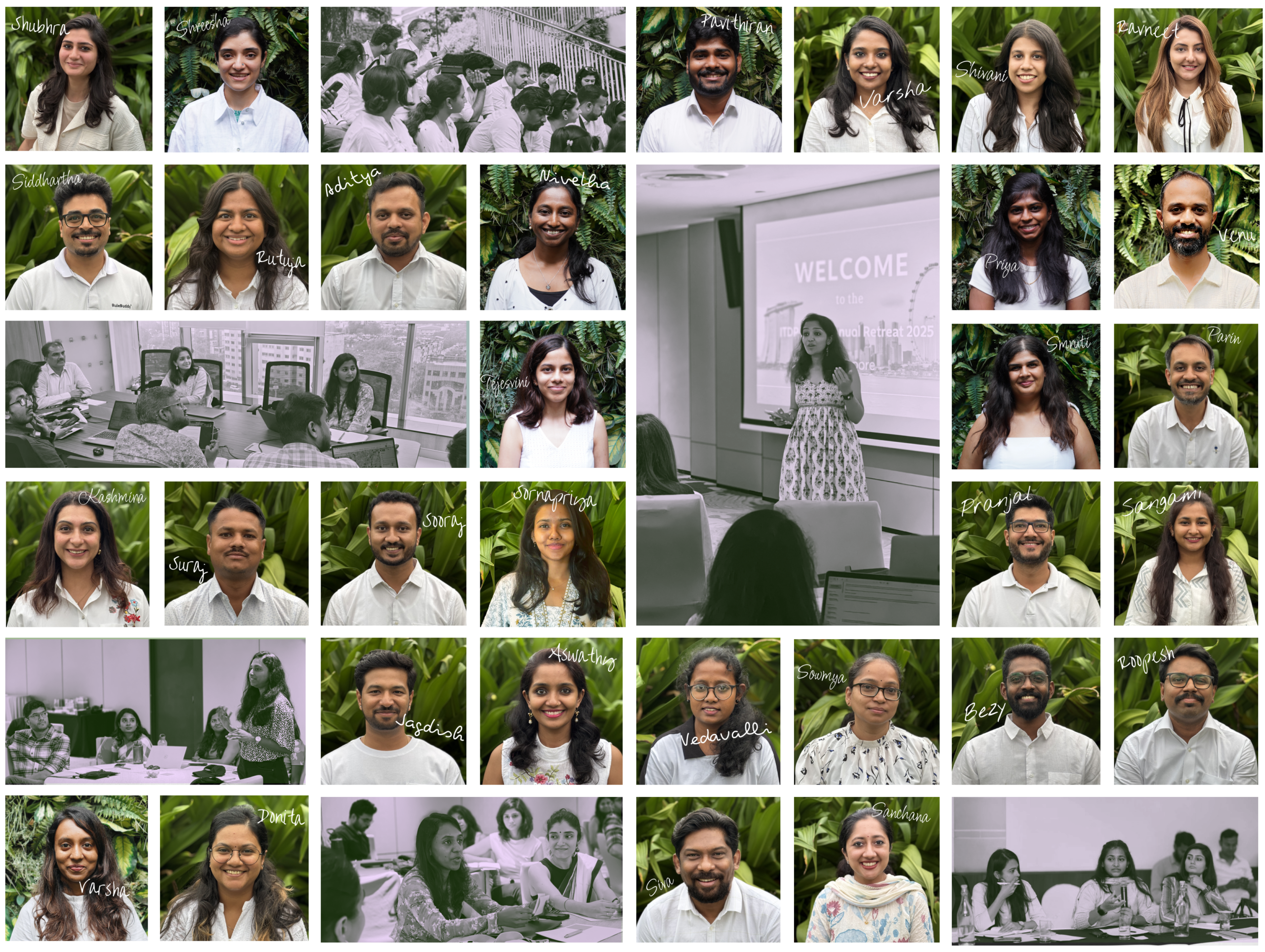
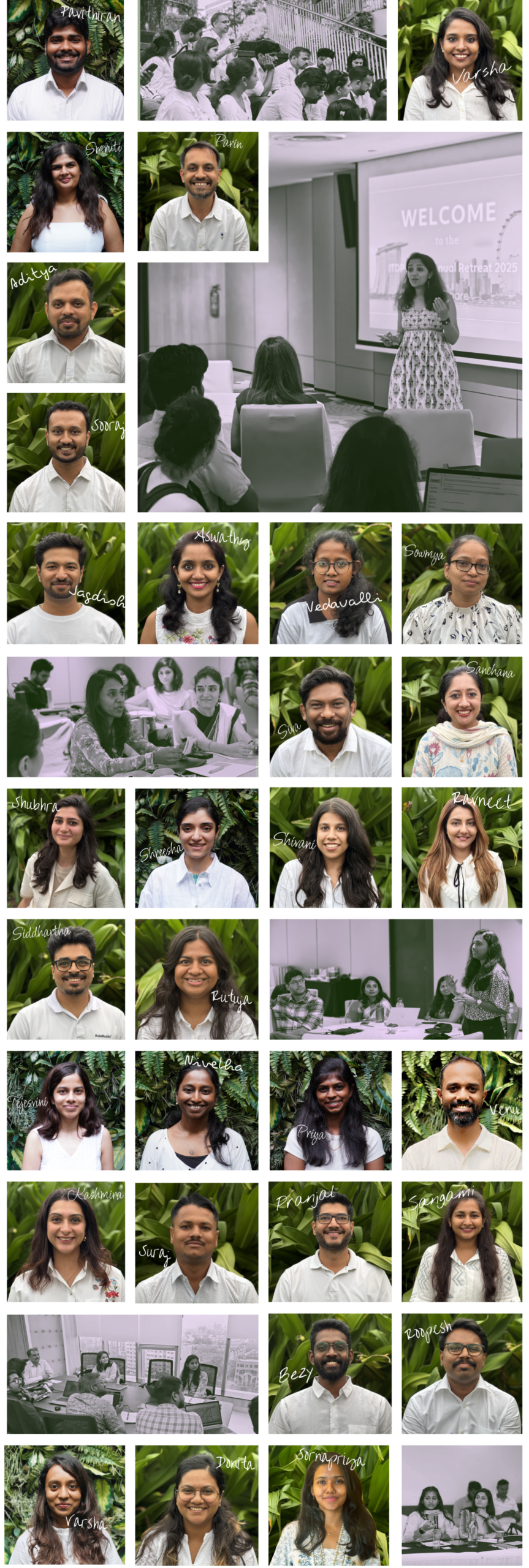
As we step into 2026, we know we are not just laying bricks; we are shaping the cities we want to live and move in. With razor sharp focus on the shared purpose and partnership in our lighthouse and newer cities, that larger vision of sustainable future is only becoming clearer!